All Posts By

Mapping Media Freedom

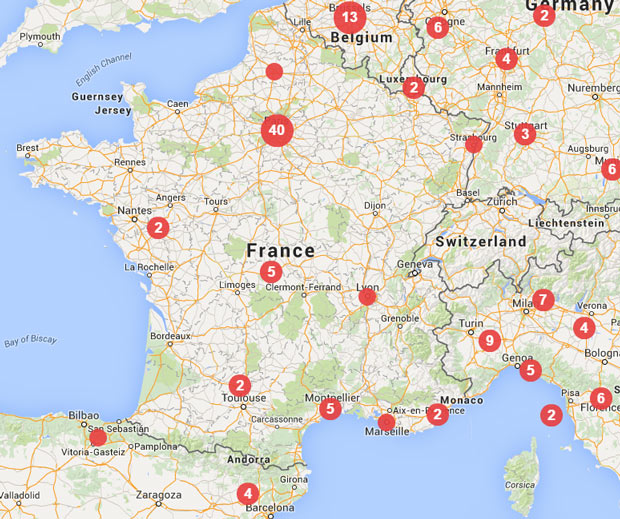
France: Vincent Bolloré’s takeover of Canal Plus sparks concern for press freedom

By | Features, Mapping Media Freedom

france-11215

Vincent Bolloré is known for business takeovers. Now 63, he has built an empire in energy, agriculture, transport and logistics.

The billionaire is also a media mogul with expanding interests. His investment group Bolloré, named for its president and CEO, has a majority share in Havas, a leading French advertising and PR group. It owns the cable television channel D8 and the daily newspaper Direct Matin.

Bolloré was appointed as president of Vivendi, the French mass media company, in June 2014. Vivendi owns Canal Plus, a French subscription-based television channel known for its irreverent tone, where Bolloré became chairman last September. Read More
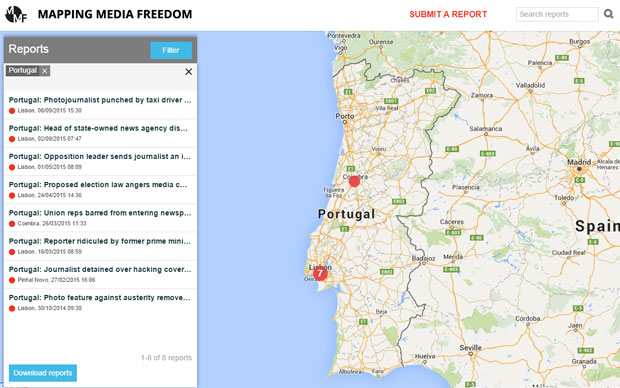
Portugal’s journalists under pressure from Angolan money

By | Features, Mapping Media Freedom

portugal-media-violations

It all became perfectly clear in Miguel’s head when a high-ranking editor from his newspaper eagerly approached him one day with a story idea. It was August 2012, and the Angolan presidential elections were scheduled for the 31st.

“You’re going to write an article that will prove once and for all to the Portuguese audience that Angola is a true democracy and not dictatorship. We’ll show that it is the Portuguese who are the fascists here, not the Angolan,” the editor told him. Read More

Russia: Attempted murder of Oleg Kashin a symbol of impunity for attacks on journalists

By | Features, Mapping Media Freedom

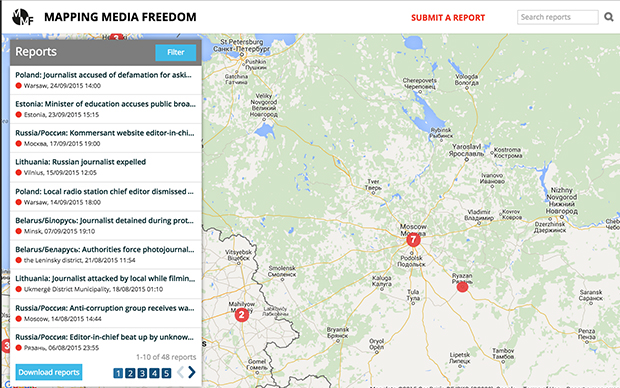
russia

On 6 November 2010, prominent Russian journalist Oleg Kashin was badly beaten with a steel pipe on his doorstep and nearly killed. He suffered a broken skull and injuries to his legs and hands — including broken fingers and one amputated digit. He was hospitalised in a coma and spent months recovering. Dmitry Medvedev, who was then President of Russia, visited him promising that the case would be solved and the attackers would be punished.

At the time, Kashin’s editor told the BBC that the attack was retribution for articles he had written and that he had recently reported on anti-Kremlin protests and extremist rallies.

Two months prior to the assault, Kashin had had an online quarrel with Andrey Turchak, the powerful governor of the Pskov region Read More

Joint international emergency press freedom mission

By | Features, Mapping Media Freedom, statement, Turkey

Concern over the deteriorating state of press freedom in Turkey and its impact on upcoming Nov. 1 parliamentary elections have prompted a coalition of international free expression groups to undertake an emergency press freedom mission to the country, the International Press Institute (IPI) announced.

From Oct. 19 to 21, mission participants will meet in Istanbul and Ankara with journalists, political representatives and foreign diplomats to demonstrate solidarity with their colleagues in the news media and to focus attention in Turkey and abroad on the impact the growing pressure on independent media is likely to have on the election. Read More

North Macedonia: Government advertising undermines role of journalism

By | Features, Mapping Media Freedom, North Macedonia

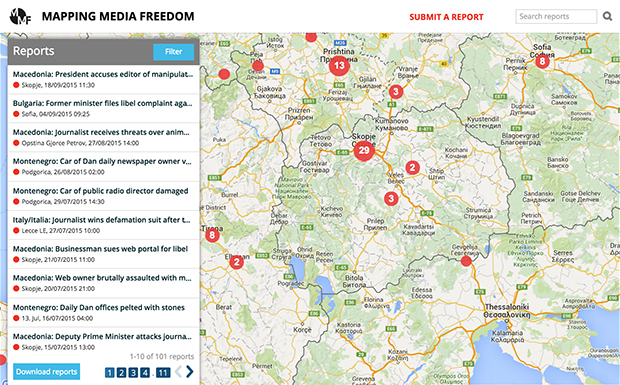
macedonia

The successor nations to the former Yugoslavia are among the most difficult places for journalists to work in Europe, a fact borne out by the latest quarterly report from Index on Censorship’s Mapping Media Freedom project. In the case of North Macedonia there have been 35 verified incidents since the project began in May 2014.

Journalists have been subjected to verbal threats, online trolling, intimidation and physical assaults against their person and property. But another issue afflicting North Macedonia’s 200 media outlets is more insidious: government advertising budgets of €30-40 million that warp the market and act as a constraint on media outlets and journalists alike. Read More

Russia’s targeting of NGOs ensnares journalist associations

By | Features, Mapping Media Freedom

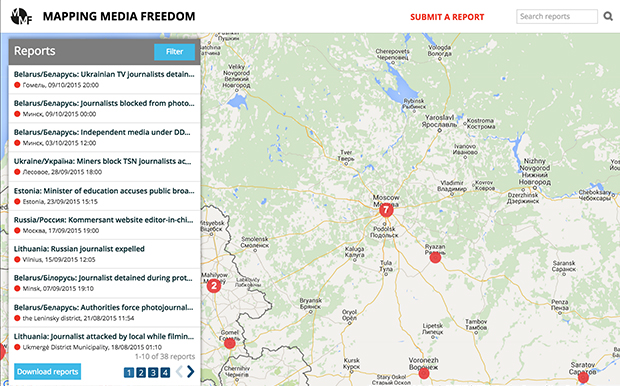
Russia MMF

The return of Vladimir Putin as president of the Russian Federation in 2012, after a wave of protests, was followed by the implementation of a new law that required non-governmental organisations receiving foreign support — in the form of funding or material aid — and engaged in “political activity” to register as “foreign agents” with the Ministry of Justice. Read More