All Posts By

Mapping Media Freedom

Dutch journalist Frederike Geerdink on her recent deportation from Turkey

By | Features, Mapping Media Freedom, Turkey

Turkey

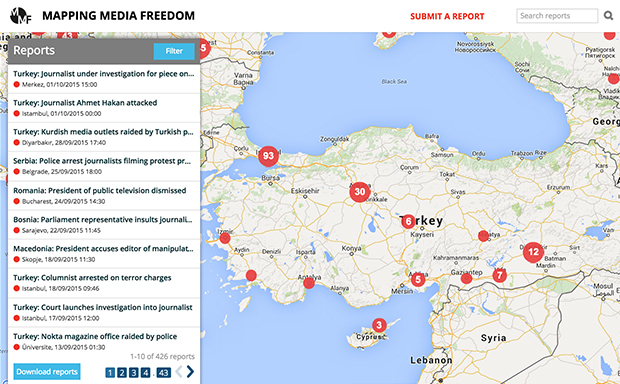
The top of Frederike Geerdink’s blog, Kurdish Matters, still reads: ‘The only foreign journalist based in Diyarbakir’. The Dutch reporter was the only foreign journalist in Turkish Kurdistan until 9 September 2015 when she was deported from the country she lived and worked for nine years.

“There I went in a military convoy, first from Yüksekova to Hakkari, then from Hakkari to Van,” Geerdink wrote a few days later. “As the soldiers were playing loud, rousing nationalist music, I realised that I had turned into a PKK target, being transported on a dark mountainous Kurdistan road in a military vehicle with windows too small to see the starry sky.” Read More
Freelance journalists in Belarus face fines for working with foreign media

By | Features, Mapping Media Freedom

belarus

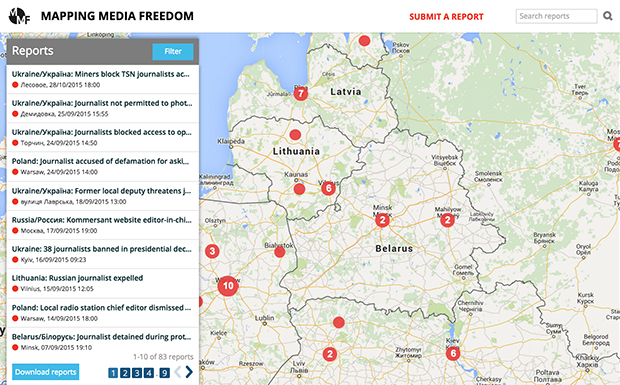
In Belarus, dozens of freelance journalists were fined between 2014 and 2015 for working for foreign media without an accreditation from the Ministry of Foreign Affairs. In a country dominated by state-run media, foreign outlets offer an alternative source of information.

Under Belarusian law, freelance journalists who co-operate with foreign media outlets are not considered legal employees of the organisation in question and aren’t entitled to receive the required accreditation. The first freelancer penalised was videographer Ales Dzianisau from Hrodna, a city in western Belarus. He was accused of illegally producing a video which ran on Belsat TV — a Polish state-run channel aimed at providing an alternative to the censorship of Belarusian television — about the opening night of a rendition of Goethe’s play Faust. He was fined €300. Read More

Journalists covering refugee crisis attacked by Hungarian police

By | Features, Mapping Media Freedom

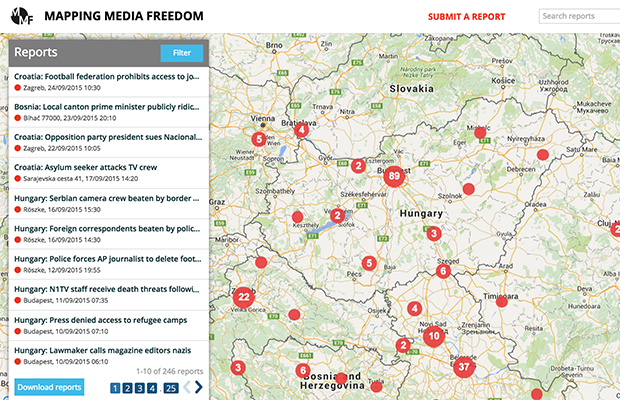
At least eight journalists were beaten and three detained as they covered a clash between refugees and the Hungarian police at the border with Serbia on 16 September.

Among those attacked were Swedish photographer Meli Petersson Ellafi, Jordan Davis, a journalist at Swiss RTS, and an entire film crew working for Radio Television of Serbia. They were covering events at the Horgoš-Röszke highway border crossing, which the Hungarian authorities had blocked the day before, leaving around 2,000 refugees stranded on the Serbian side. Read More

Balkans: “Media has a significant role in the theatre of the absurd”

By | Features, Mapping Media Freedom

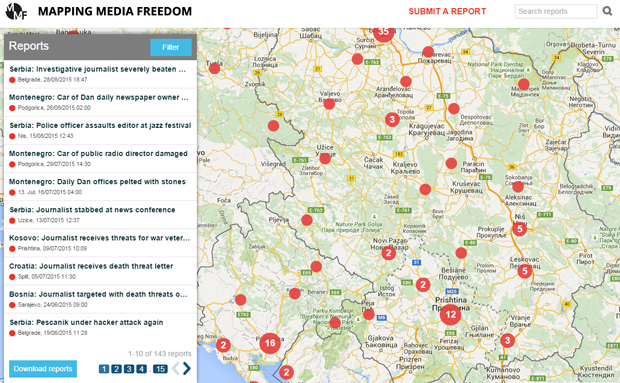
balkans-map

“Media has a significant role in the theatre of the absurd,” a participant in a conference on the security and protection of journalists in western Balkan countries claimed.

Media workers and representatives from journalists’ associations in Croatia, Bosnia and Herzegovina, Serbia and Montenegro joined representatives of international organisations in Sarajevo in June 2015 to debate key issues facing the media in the region: attacks on journalists, impunity, the effectiveness of the legal system and institutional mechanisms to create a safe environment to  work in. Read More

Ukraine: “Serious blow to media freedom”

By | Features, Mapping Media Freedom, statement

Ukrainian President Petro Poroshenko signed a decree on Wednesday 16 September banning at least 38 international journalists and bloggers from Ukraine for one year. The decree, published on the presidential website, says those listed are banned for being “actual or potential threat to national interests, national security, sovereignty and territorial integrity of Ukraine.”

Poroshenko said the people targeted were involved in Russia’s 2014 annexation of Crimea and the current aggression in eastern Ukraine.

“This ban is a serious blow to media freedom,” Index senior advocacy officer Melody Patry said. “There is no explanation whatsoever on what press coverage constitutes an actual or potential threat to national security. We appreciate that the situation in eastern Ukraine is sensitive but preventing journalists from reporting from within the country is not the solution and it’s undermining freedom of information.” Read More