All Posts By

Mapping Media Freedom

Poland: Worrying implications of defamation through the criminal code

By | Features, Mapping Media Freedom

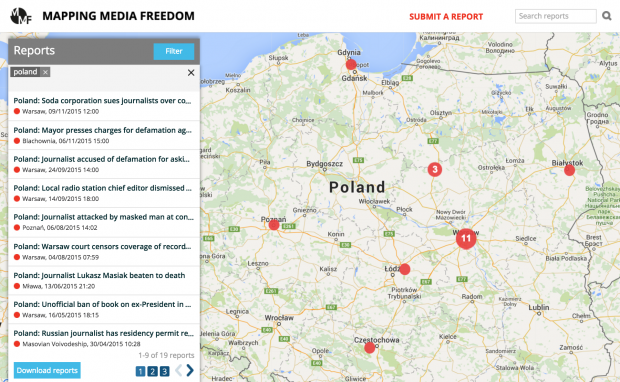
Poland map

Fact-checking is crucial for any piece of journalism. This was what the investigative journalist Jaroslaw Jakimczyk set out to do when he wrote an email to the press office at IT and technology company Qumak S.A. requesting authentication of information he had.

The company, which is based in Warsaw, provides information and communication services to well-known clients, such as the major Polish bank Pekao. Jakimczyk’s questions pertained to discs of private client data that, according to his information, there was proof of a transaction of sale between the two parties. When Jakimczyk received a response from Qumak’s press office in late September, the denial of any wrongdoing on their part was followed swiftly by something rather unexpected: Qumak was now pressing charges against Jakimczyk for defamation under article 212 of the Polish penal code. Read More
France’s state of emergency poses threat to press freedom

By | Features, Mapping Media Freedom
shutterstock_332590868

Editorial Credit: Frederic Legrand – COMEO / Shutterstock.com

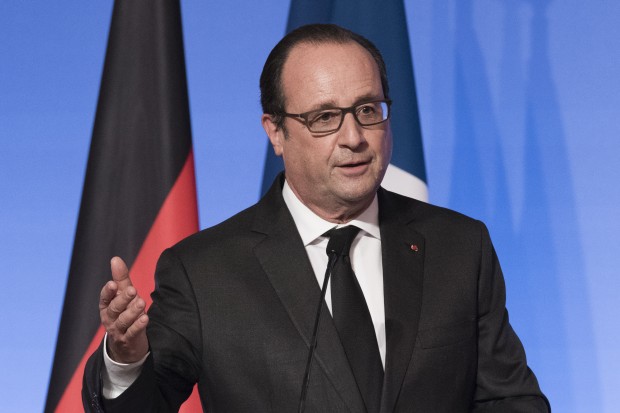
Even before the attacks on Paris on 13 November were over, French President Francois Hollande declared a nationwide state of emergency giving authorities additional powers in the name of protecting citizens and combatting terrorism. But since the attacks, concerns have been raised for press freedom prompted by the cancellation of a regular radio segment by journalist Thomas Guénolé.

A few days after the events of 13 November, Guénolé devoted his daily morning commentary piece on RMC radio to what he perceived as the failings of the French security services and police Read More

Exploring challenges to press freedom across Europe

By | Features, Free Our Media, Mapping Media Freedom

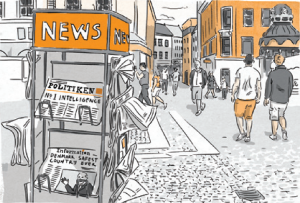
Screen Shot 2015-11-25 at 17.28.59A new graphic novel exploring challenges to press freedom across Europe and the impact of limitations on journalists has been released by the European Youth Press.
Free Our Media is the result of a collaborative effort over the course of several months by a team of young journalists and illustrators assembled from all over Europe by European Youth Press, and contains 14 comics, each story centred on the state of media freedom in a different country. The project was funded by the Council of Europe.

Planning for Free Our Media started in autumn of 2014, when the European Youth Press team began outlining which media advocacy issues the organisation would focus on in 2015. Press freedom was high on the list of priorities, given its recent deterioration in the EU and neighbouring countries, and the organisation’s resolve to tackle this particular issue was only heightened by the violent attacks on satirical French newspaper Charlie Hebdo in January 2015. Read More

Russia: Media freedom NGO faces closure

By | Features, Mapping Media Freedom

The Russian Ministry of Justice has added Glasnost Defence Foundation (GDF) to the list of NGOs it considers foreign agents. The decision was made after an “unplanned inspection”, Radio Liberty reports.

GDF, founded in 1991, is one of Russia’s oldest human rights organisations protecting freedom of the media. It provides Russian journalists with legal information and support. It also monitors media freedom abuses. GDF is the founder of the Andrey Sakharov journalist prize, Journalism As A Deed. The organisation has been headed by a well-known human rights defender, filmmaker and critic, Alexei Simonov. Read More

Russia’s regional media: Cowed, controlled and silenced

By | Features, Mapping Media Freedom

When the Tomsk-based station TV-2 ceased broadcasting earlier this year, Siberia lost one of its few independent stations. The channel was about as free as media can be in Russia: it wasn’t funded by a state or municipal budget.

The road to its closure began in April 2014 when an antenna malfunctioned. It took 45 days to get back on the air. When it resumed transmission in June 2014, Roskomnadzor – the Russian authority that oversees media and communications – revoked the station’s right to broadcast. A previous licence extension though 2025 had been issued as a result of a “computer error”, the agency explained.

On 1 January 2015, the station stopped broadcasting over the airwaves. In February 2015, it ceased to be an internet and cable station as well. Read More

Belarus: Media violations recorded during last month’s election

By | Belarus, Mapping Media Freedom

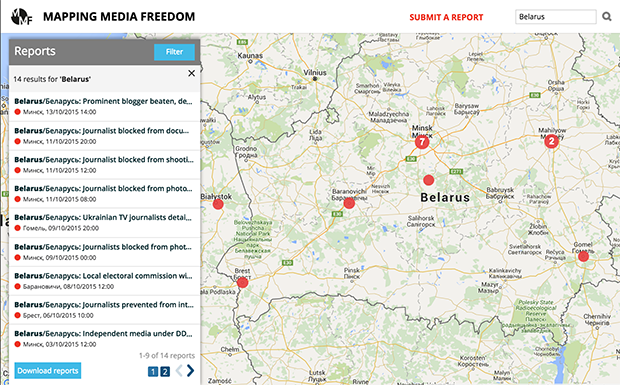
Belarus map

On 11 October, Belarusian president Aleksander Lukashenko won his fifth consecutive election. Whether it was a free and fair election is up for debate.

Belarusian observers, particularly Human Rights Defenders for Free Elections, note the electoral process did not meet a number of core international standards. Claims include that candidates did not receive equal media access, there was a lack of impartiality among election commissions and administrative resources were used in favor of the incumbent. While ballots were cast, political prisoners were held in penitentiaries and there were reports of journalists being harassed. Read More