All Posts By

Mapping Media Freedom

Photo of Slovenian national officials meeting during the corona crisis. All are wearing masks.

Under guise of Corona prevention: Governments’ measures threaten press freedom

By | COVID_19, European Union, Features, France, Germany, Italy, Mapping Media Freedom, media freedom featured, Slovenia, Spain, Ukraine

by Jane Whyatt

Across Europe, governments are taking necessary steps to stop the spread of COVID-19. But some are exploiting the health crisis to repress critical questions and restrict journalists’ work.

Photo of Slovenian national officials meeting during the corona crisis. All are wearing masks.

Officials wear masks at an emergency meeting to discuss the corona crisis in Slovenia. Photo: Government of Slovenia Twitter

Meanwhile, disinformation and conspiracies are spreading unchecked in social media and online blogs. The European Centre for Press and Media Freedom (ECPMF) has issued a statement calling on Europe’s leaders to respect the right of journalists to do their jobs unhindered, so that citizens can continue to receive up-to-date and fact-checked information.

The Czech Republic

This comes after several repressive moves by European states, starting with the Czech Republic, where Prime Minister Andrej Babis restricted the number of journalists who were allowed to enter a press conference. Freelance journalist Lucie Sykorova, chair of ECPMF’s Supervisory Board, is based in the Czech Republic and raised concerns about possible political interference to stifle critical questions, by limiting the number of persons at a press conference under the guise of preventing transmitting the virus.

Spain

Meanwhile in Spain, where the incidence of Coronavirus cases in Europe, is second highest after Italy, the Royal Decree Number 463/2020, of 14.March was denounced by ECPMF’s partner organisation Plateforma por la Difensa di Libertad del Informacion (PDLI).  Citing legal expert Joan Barata from Stanford University, the PDLI expressed concern that the decree enables the state to insert its own messages into all news media outlets, including movie streaming and videos on demand. Barata maintains that this can be allowed under Article 10 of the European Convention on Human Rights (freedom of expression) only under certain circumstances as follows:

 “A provision of this nature is only acceptable as a limit to freedom of expression and information (even in the context of the state of alarm) if a series of circumstances occurs:

a) The messages are genuinely public service because they provide necessary information to the citizen that cannot be effectively disseminated in any other way (or that requires the complementary use of this mechanism).

b) For this reason, the messages disseminated cannot consist of mere institutional advertising, messages of a purely political or partisan nature, or pure and simple propaganda from the authority on duty.

c) In the event of non-compliance with this obligation, the sanctions must always be proportional to the circumstances of the corresponding media, to its resources and capacity to comply with the requirement received.”

Slovenia

A smear campaign has started against government critics in Slovenia, targeting investigative journalist Blaž Zgaga, the poet Slavoj Žižek and the philosophers Boris Novak and Darko Štrajn. It appears to have been prompted by Zgaga’s Freedom of Information request relating to emergency meetings of the National Security Council and its anti-corona operations.

Italy

In Italy, a state of lockdown continues but the Rome-based observatory Ossigeno per l’informazione continues to monitor violations of press and media freedom, including restrictions imposed by governments on freedom of expression.

Some positive news for media workers

France

However, there are also positive moves to blunt the impact of the virus on journalists’ work. In France, shops that sell newspapers are among the few that are allowed to stay open. This helps to guarantee an income for those who are employed in the mainstream media.

Germany

The German Culture Ministry has opened a special fund for freelancers, including artists, musicians and other creative workers as well as journalists.

“We won’t leave workers in the cultural industries to face this alone,” says Culture Minister Monika Grütters. Furthermore, the journalists’ union DJV (Deutscher Journalisten-Verband) is offering advice to freelancers on how to survive.

At the European level, the European Federation of Journalists (EFJ) is also trying to protect non-standard workers and all trade union members who are struggling to get paid during the crisis. The EFJ urges all governments to offer payment to those who are quarantined, suspended or made redundant because of the COVD-19 outbreak. The Federation urges:

“Particular attention must be paid to precarious and non-standard workers (including freelance journalists), who are often excluded from the same rights and protections as other workers.”

Focus on truth

The wave of disinformation about corona currently flooding Ukraine’s media and social networks is described by the Kiyv Post as ‘mainly originating from Russia’. It is especially damaging in a country where trust in the health system and in mainstream media is low. ECPMF is co-operating with a local partner in a media literacy project, re:start democratic discourse, aiming to help grassroots local reporters to resist censorship and counter propaganda by producing quality journalism.

Obliged to stay indoors by the corona pandemic, the Brussels-based media literacy campaign Lie Detectors is developing new ways to deliver its unique workshops online to school and college teachers. In normal times, the Lie Detectors bring local journalists and media specialists into classrooms to deliver interactive lessons on how to spot fake news, verify facts and photos and de-bunk conspiracies. With schools closed, they are moving online to train the trainers at a time when critical thinking skills are needed most. Lie Detectors is a partner organisation of ECPMF. It is a non-profit funded independently by the Wyss Foundation.

Serbia’s public TV ‘is being used against the public‘

By | Features, Serbia
Every Saturday protestors gather in Belgrade demanding an end to government propaganda

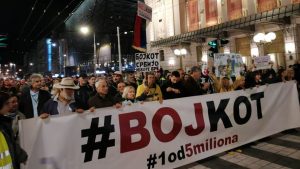
Weekly Saturday demonstrations outside the RTS HQ in Belgrade. Photo: N1.tv

By Jovanka Matic

The public broadcaster Radio Television of Serbia, RTS, is highly popular and highly controversial. It tops the ratings. Yet, for more than 12 months, every Saturday, citizens of Serbian capital Belgrade have been protesting against RTS because of its pro-government bias.

The first anti-government citizens’ rally on 8 December 2018, named ‘Stop the Blood-stained Shirts’, followed an incident in which an opposition leader had been beaten before meeting his supporters in a provincial town. Along with widespread political violence, the lack of media freedom has remained the major issue amongst demonstrators’ grievances all along. Most of all, citizens are dissatisfied with the functioning of the public TV broadcaster. They say it makes a mockery of the RTS slogan “Your right to know everything”.

RTS had not only omitted to cover the blood-soaked shirt of the opposition leader but for months it kept silent about citizen protests – even when demonstrators whistled and shouted under the windows of its own TV offices. For more than a year, its prime-time news bulletin never reported live on the Saturday protests.  Nor did it air a single sound-bite of speakers at the rallies.

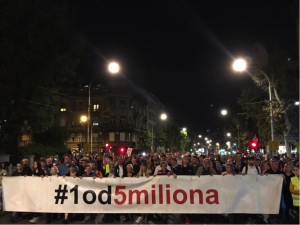
The protests are now named “1 of 5 million” because the President of Serbia Aleksandar Vucic said he would not meet his opponents’ demands, even if they numbered five million people.

In 2018, RTS attracted 19,4% of viewers every day,

The top commercial channel TV Pink attracted 16,7% of viewers.

Out of 50 TV shows with the largest audience, 49 were aired by RTS.

The process of violating the citizens’ right to know was initiated in 2012, with the establishment of the new government, led by Aleksandar Vucic’s Serbian Progressive Party. By 2017, starting first as the Deputy Prime Minister, then becoming Prime Minister and lastly President of Serbia, Vucic managed to turn Serbia into a populist autocracy, with his own strong  personality cult. The government controls all major financial transactions in the country. It nurtures clientelist relations with many economic sectors and social groups. It has placed party loyalists in all state institutions, including the independent oversight agencies. The judiciary is highly inefficient and guided by political forces.. Elections are held under unfair conditions and there is strong pressures on voters, especially those who are employed in public companies. Political opposition is strenuously delegitimised on a daily basis.

Media capture

The media form one of the strategic pillars of the Vucic regime. Pro-government content dominates all five TV companies with national frequencies, including public service broadcaster RTS,  and  all but one of eight national daily newspapers (four tabloids and two semi-tabloids). Radio is rarely an important news source, as most stations have shifted to playing music. There are numerous online media, but here there is massive interferences from trolls, engaged by the ruling party, who distort the “public debate”.

The media capture was made possible by a highly unregulated media system and weak regulatory bodies and state institutions in charge of the sector. The media market is small, poor, oversaturated, non-transparent and deregulated. There are no conditions for media sustainability: more than 2,000 media compete for about 200 million euros of advertising revenue  The media business is not profitable, even when it is highly commercialised. Journalists’ salaries are lower than the country’s overall average, which is less than 500 euros a month. Media owners are either close to the ruling party or they compensate for the losses in their media business by running profitable businesses in other sectors. The. owners of the major media advertising agencies are also close to the ruling party. Most media outlets, especially the local ones, are highly dependent on the public money. The Ministry of Culture and Information and the Regulatory Body for Electronic Media refrain from taking action on the functioning of the media under the pretense that they must avoid interfering with the freedom of expression.

Most media function on a “quid pro quo” basis: they receive advertising contracts, tax reliefs or subsidies and public funds for new production if they deliver favourable coverage of the government and negative coverage of its opponents.

The most powerful media function as the megaphones and record players of the government discourse, especially of the President, Vucic, who conducts a permanent election campaign. He makes public appearances almost every day, by holding media conferences, delivering special addresses, holding public events to celebrate government achievements, appearing as a guest in all kinds of media shows, giving special interviews, etc.

Some independent media do exist. However, there are only a few and their reach is very limited. They include a private news agency, the cable channel N1 (an affiliate of CNN), one daily newspaper with the lowest circulation of all papers, several news magazines, and several highly professional and internationally rewarded investigative centers (BIRN, Krik, CINS), whose work is ignored by the major media.

The role of RTS in the media orchestra

The pro-regime media function like a well-conducted orchestra, which provides specific messages to different segments of the population.

National commercial television networks and the tabloid press are characterised by a very low diversity of content. The two most popular television networks broadcast news and reality programmes which last up to 8 or 11 hours a day. The tabloids are focused on political news and show-business news.

Commercial television networks promote Serbia’s orientation towards the European Union (EU), which is the official policy, while the tabloid press prefer Serbia’s connections with Russia and emphasise the hostility between the EU and Russia.

Both carry out extremely harsh smear campaigns, sometimes lasting for months, against the opposition and opposition leaders and also all other organisations or individuals with critical attitudes towards the government. This is done by massive violations of professional ethics, using hate speech and fake news with the clear aim of de-stabilising the opposition. In three months during 2019, four tabloid dailies violated the Code of Journalists 1,880 times just in the headlines of their articles. Court processes for violations of human dignity in the media content are very slow and inefficient.

RTS differs significantly from both these media groups. Its content is very diverse – and no wonder, since it is the largest media company in the country, with 2,900 employees.

The RTS media discourse is decent. It does not offend, does not carry hate speech. Nor does it mount aggressive attacks on government critics. RTS’s strategy is to ignore them. It silences any opinion that criticises the government. Its agenda completely coincides with the government agenda. The RTS prime-time news bulletin, the most popular in the country, covers only government definitions of events and incidents and never problematises them. Nor does it investigate controversial issues. Therefore there is a popular joke in Serbia: “If I could only live in the country depicted in the RTS news.”

Mechanisms of RTS capture

Like most other media, RTS is dependent on government-controlled money. It gets 46% of its revenues from the licence fee, 28% from the state budget and 22% from advertising and other commercial activities. The Law on Public Media Broadcasters (2014) prescribes that their main source of finances should be the licence fee paid by citizens, 500 dinars a month (about 4 euros). However, the fee was introduced only in 2016, when the amount was 150 dinars (somewhat above 1 euros), while the government financed the public broadcasters from the state budget. This arrangement is still valid, since the licence fee is now set at 220 dinars (about 2 euros), which is the cost of a cup of coffee in a Belgrade restaurant.

This lack of financial independence is accompanied by the lack of editorial independence and independent governance. The Managing Board of RTS is elected by the Regulatory Body for Electronic Media. However, this body has not managed to obtain independence from political interests since its establishment in 2003. Its choices of the members of the Managing Board of RTS have always been controversial in terms of their professional capacities and susceptibility to political pressures.

The Managing Board elects the Director General and main editors, based on the the Director proposed candidates.  In 2017 researchers working on the control of the media interviewed journalists from RTS. They said their editors are subjected to daily pressures from government and ruling party officials on how to run their programmes.

Many RTS journalists believe that their responsibility is primarily to the state institutions, rather than to the citizens. Their professional culture gives priority to the government and ruling parties – often according to the number of seats they take in the Parliament – while the opposition is usually considered a negative political pole. The political culture of the Serbian political elite is also detrimental to public service broadcasting. Every political party, while in opposition, has promoted freedom of the media. But once they become the government, they accept the public service media as a further electoral gain and use various channels to influence its functioning in their own interest.

Serbian nightmare

Serbian citizens are experiencing the nightmare of captured media for the second time since political pluralism was established in 1990. In contrast to Central European countries which embarked on dismantling the state control over media after the first multy-party elections, Serbia under the rule of Slobodan Milosevic faced a retrograde process. The relative autonomy of state media under liberal Yugoslav socialism was completely abolished. The media – TV in particular – were turned into a classical propaganda apparatus for mobilising the Serbian nation against their surrounding ethnic enemies in Slovenia, Croatia, Bosnia and Kosovo. Critics of Milosevic’s nationalistic and warlike policy were banned in the state media and discredited as traitors and foreign mercenaries. The regime collapsed in 2000 and then Serbia started its media transformation process, lagging 10 years behind the other post-communist countries.. There was a widespread belief that the practices of journalistic dishonesty that were commonplace in the 1990s must not be repeated.

However, the new structure of the media system has not developed strong enough safeguards against the new process of media capture. Almost all the media are now privatised but the media is controlled by unregulated and non-transparent funding instead of through state ownership. The broadcasting Regulator fails to implement the media laws. The lack of protection for media and journalists’ independence and their precarious economic position mean that they are unable to resist the pressure of vested political and commercial interests.

The role of the EU

Another important difference is that in the 1990s the European Union helped the Serbian independent media a great deal, since they promoted peace and democratic discourse against the practice of the Milosevic regime. The European Union today supports the regime of Aleksandar Vucic, who was an extreme Serb nationalist in the 1990s, when he served as the Minister of Information and was known for imposing harsh financial punishments on the independent media. Under the auspices of the EU, as a candidate country for EU membership, Serbia is allowed to disregard many important reforms that would make her close to EU standards and values as long as its leader, as a typical strongman, provides stability in regional relations and keeps promising to settle the issue of Kosovo, which is an important security threat to stability in the Western Balkans.

Serbian political actors who support media freedom and democracy are left alone to fight the autocratic populism, which very much resembles that of Russia, Hungary and Turkey.

Propping up media freedom is the most important issue in their attempt to secure conditions for free and fair elections, which are scheduled for spring 2020. On behalf of protesting citizens, an expert group has formulated demands for change in order to normalise political communications in Serbia.These demands and recommendations are supported by the main opposition group, the Alliance for Serbia. Their demands concern changes in the communications of the President, Ministry of Culture and Information, broadcasting Regulator and Agency for Fighting Corruption, and in the functioning of the public service broadcaster RTS. It is required to provide coverage of topics of greatest interest to the audience, greater pluralism of news and more debate programmes with genuine confrontation between relevant opposing views long before the election campaign starts.

In the autumn of 2019, the new EU Parliament facilitated a dialogue between the government and opposition regarding the conditions for the election. Unfortunately, the media were not given the importance they deserve in these negotiations. The EU Parliament representatives were satisfied. But the citizens of Belgrade still continue their protests every Saturday.

Protestors gather every weekend under the banner'one in five million' to demand an end to state propaganda

Serbia’s public TV ‘is being used against the public‘

By | Features, Mapping Media Freedom, Serbia
Protestors under the bannder 'Onein five million' demonstrate every weekend in the Serbian capital Belgrade.

Demonstrators against state capture of RTS. Photo: Twitter

The public broadcaster Radio Television of Serbia, RTS, is highly popular and highly controversial. It tops the ratings. Yet, for more than 12 months, every Saturday, citizens of Serbian capital Belgrade have been protesting against RTS because of its pro-government bias.

The first anti-government citizens’ rally on 8 December 2018, named ‘Stop the Blood-stained Shirts’, followed an incident in which an opposition leader had been beaten before meeting his supporters in a provincial town. Along with widespread political violence, the lack of media freedom has remained the major issue amongst demonstrators’ grievances all along. Most of all, citizens are dissatisfied with the functioning of the public TV broadcaster. They say it makes a mockery of the RTS slogan ‘Your right to know everything’.

RTS had not only omitted to cover the blood-soaked shirt of the opposition leader but for months it kept silent about citizen protests – even when demonstrators whistled and shouted under the windows of its own TV offices. For more than a year, its prime-time news bulletin never reported live on the Saturday protests.  Nor did it air a single sound-bite of speakers at the rallies.

The protests are now named ‘1 of 5 million’ because the President of Serbia Aleksandar Vucic said he would not meet his opponents’ demands, even if they numbered five million people.

Fact and figures:

In 2018, RTS attracted 19,4% of viewers every day,

The top commercial channel TV Pink attracted 16,7% of viewers.

Out of 50 TV shows with the largest audience, 49 were aired by RTS.

The process of violating the citizens’ right to know was initiated in 2012, with the establishment of the new government, led by Aleksandar Vucic’s Serbian Progressive Party. By 2017, starting first as the Deputy Prime Minister, then becoming Prime Minister and lastly President of Serbia, Vucic managed to turn Serbia into a populist autocracy, with his own strong  personality cult. The government controls all major financial transactions in the country. It nurtures clientelist relations with many economic sectors and social groups. It has placed party loyalists in all state institutions, including the independent oversight agencies. The judiciary is highly inefficient and guided by political forces.. Elections are held under unfair conditions and there is strong pressures on voters, especially those who are employed in public companies. Political opposition is strenuously delegitimised on a daily basis.

Media capture

The media form one of the strategic pillars of the Vucic regime. Pro-government content dominates all five TV companies with national frequencies, including public service broadcaster RTS,  and  all but one of eight national daily newspapers (four tabloids and two semi-tabloids). Radio is rarely an important news source, as most stations have shifted to playing music. There are numerous online media, but here there is massive interferences from trolls, engaged by the ruling party, who distort the “public debate”.

The media capture was made possible by a highly unregulated media system and weak regulatory bodies and state institutions in charge of the sector. The media market is small, poor, oversaturated, non-transparent and deregulated. There are no conditions for media sustainability: more than 2,000 media compete for about 200 million euros of advertising revenue  The media business is not profitable, even when it is highly commercialised. Journalists’ salaries are lower than the country’s overall average, which is less than 500 euros a month. Media owners are either close to the ruling party or they compensate for the losses in their media business by running profitable businesses in other sectors. The. owners of the major media advertising agencies are also close to the ruling party. Most media outlets, especially the local ones, are highly dependent on the public money. The Ministry of Culture and Information and the Regulatory Body for Electronic Media refrain from taking action on the functioning of the media under the pretense that they must avoid interfering with the freedom of expression.

Most media function on a “quid pro quo” basis: they receive advertising contracts, tax reliefs or subsidies and public funds for new production if they deliver favourable coverage of the government and negative coverage of its opponents.

The most powerful media function as the megaphones and record players of the government discourse, especially of the President, Vucic, who conducts a permanent election campaign. He makes public appearances almost every day, by holding media conferences, delivering special addresses, holding public events to celebrate government achievements, appearing as a guest in all kinds of media shows, giving special interviews, etc.

Some independent media do exist. However, there are only a few and their reach is very limited. They include a private news agency, the cable channel N1 (an affiliate of CNN), one daily newspaper with the lowest circulation of all papers, several news magazines, and several highly professional and internationally rewarded investigative centers (BIRN, Krik, CINS), whose work is ignored by the major media.

The role of RTS in the media orchestra

The pro-regime media function like a well-conducted orchestra, which provides specific messages to different segments of the population.

National commercial television networks and the tabloid press are characterised by a very low diversity of content. The two most popular television networks broadcast news and reality programmes which last up to 8 or 11 hours a day. The tabloids are focused on political news and show-business news.

Commercial television networks promote Serbia’s orientation towards the European Union (EU), which is the official policy, while the tabloid press prefer Serbia’s connections with Russia and emphasise the hostility between the EU and Russia.

Both carry out extremely harsh smear campaigns, sometimes lasting for months, against the opposition and opposition leaders and also all other organisations or individuals with critical attitudes towards the government. This is done by massive violations of professional ethics, using hate speech and fake news with the clear aim of de-stabilising the opposition. In three months during 2019, four tabloid dailies violated the Code of Journalists 1,880 times just in the headlines of their articles. Court processes for violations of human dignity in the media content are very slow and inefficient.

RTS differs significantly from both these media groups. Its content is very diverse – and no wonder, since it is the largest media company in the country, with 2,900 employees.

The RTS media discourse is decent. It does not offend, does not carry hate speech. Nor does it mount aggressive attacks on government critics. RTS’s strategy is to ignore them. It silences any opinion that criticises the government. Its agenda completely coincides with the government agenda. The RTS prime-time news bulletin, the most popular in the country, covers only government definitions of events and incidents and never problematises them. Nor does it investigate controversial issues. Therefore there is a popular joke in Serbia: ‘If I could only live in the country depicted in the RTS news’.

Mechanisms of RTS capture

Like most other media, RTS is dependent on government-controlled money. It gets 46% of its revenues from the licence fee, 28% from the state budget and 22% from advertising and other commercial activities. The Law on Public Media Broadcasters (2014) prescribes that their main source of finances should be the licence fee paid by citizens, 500 dinars a month (about 4 euros). However, the fee was introduced only in 2016, when the amount was 150 dinars (somewhat above 1 euros), while the government financed the public broadcasters from the state budget. This arrangement is still valid, since the licence fee is now set at 220 dinars (about 2 euros), which is the cost of a cup of coffee in a Belgrade restaurant.

This lack of financial independence is accompanied by the lack of editorial independence and independent governance. The Managing Board of RTS is elected by the Regulatory Body for Electronic Media. However, this body has not managed to obtain independence from political interests since its establishment in 2003. Its choices of the members of the Managing Board of RTS have always been controversial in terms of their professional capacities and susceptibility to political pressures.

The Managing Board elects the Director General and main editors, based on the the Director proposed candidates.  In 2017 researchers working on the control of the media interviewed journalists from RTS. They said their editors are subjected to daily pressures from government and ruling party officials on how to run their programmes.

Many RTS journalists believe that their responsibility is primarily to the state institutions, rather than to the citizens. Their professional culture gives priority to the government and ruling parties – often according to the number of seats they take in the Parliament – while the opposition is usually considered a negative political pole. The political culture of the Serbian political elite is also detrimental to public service broadcasting. Every political party, while in opposition, has promoted freedom of the media. But once they become the government, they accept the public service media as a further electoral gain and use various channels to influence its functioning in their own interest.

Serbian nightmare

Serbian citizens are experiencing the nightmare of captured media for the second time since political pluralism was established in 1990. In contrast to Central European countries which embarked on dismantling the state control over media after the first multy-party elections, Serbia under the rule of Slobodan Milosevic faced a retrograde process. The relative autonomy of state media under liberal Yugoslav socialism was completely abolished. The media – TV in particular – were turned into a classical propaganda apparatus for mobilising the Serbian nation against their surrounding ethnic enemies in Slovenia, Croatia, Bosnia and Kosovo. Critics of Milosevic’s nationalistic and warlike policy were banned in the state media and discredited as traitors and foreign mercenaries. The regime collapsed in 2000 and then Serbia started its media transformation process, lagging 10 years behind the other post-communist countries.. There was a widespread belief that the practices of journalistic dishonesty that were commonplace in the 1990s must not be repeated.

However, the new structure of the media system has not developed strong enough safeguards against the new process of media capture. Almost all the media are now privatised but the media is controlled by unregulated and non-transparent funding instead of through state ownership. The broadcasting Regulator fails to implement the media laws. The lack of protection for media and journalists’ independence and their precarious economic position mean that they are unable to resist the pressure of vested political and commercial interests.

The role of the EU

Another important difference is that in the 1990s the European Union helped the Serbian independent media a great deal, since they promoted peace and democratic discourse against the practice of the Milosevic regime. The European Union today supports the regime of Aleksandar Vucic, who was an extreme Serb nationalist in the 1990s, when he served as the Minister of Information and was known for imposing harsh financial punishments on the independent media. Under the auspices of the EU, as a candidate country for EU membership, Serbia is allowed to disregard many important reforms that would make her close to EU standards and values as long as its leader, as a typical strongman, provides stability in regional relations and keeps promising to settle the issue of Kosovo, which is an important security threat to stability in the Western Balkans.

Serbian political actors who support media freedom and democracy are left alone to fight the autocratic populism, which very much resembles that of Russia, Hungary and Turkey.

Propping up media freedom is the most important issue in their attempt to secure conditions for free and fair elections, which are scheduled for spring 2020. On behalf of protesting citizens, an expert group has formulated demands for change in order to normalise political communications in Serbia.These demands and recommendations are supported by the main opposition group, the Alliance for Serbia. Their demands concern changes in the communications of the President, Ministry of Culture and Information, broadcasting Regulator and Agency for Fighting Corruption, and in the functioning of the public service broadcaster RTS. It is required to provide coverage of topics of greatest interest to the audience, greater pluralism of news and more debate programmes with genuine confrontation between relevant opposing views long before the election campaign starts.

In the autumn of 2019, the new EU Parliament facilitated a dialogue between the government and opposition regarding the conditions for the election. Unfortunately, the media were not given the importance they deserve in these negotiations. The EU Parliament representatives were satisfied. But the citizens of Belgrade still continue their protests every Saturday.

Dr Jovanka Matic was a research fellow at the Belgrade Institute of Social Sciences for 25 years until 2019, specialising in media freedom and the role of media in democracy. She is the author of  7 books and around 70 learned articles on the subject.

Police brutality against French journalists: a worrying situation

By | Features, France, Mapping Media Freedom, Media Freedom
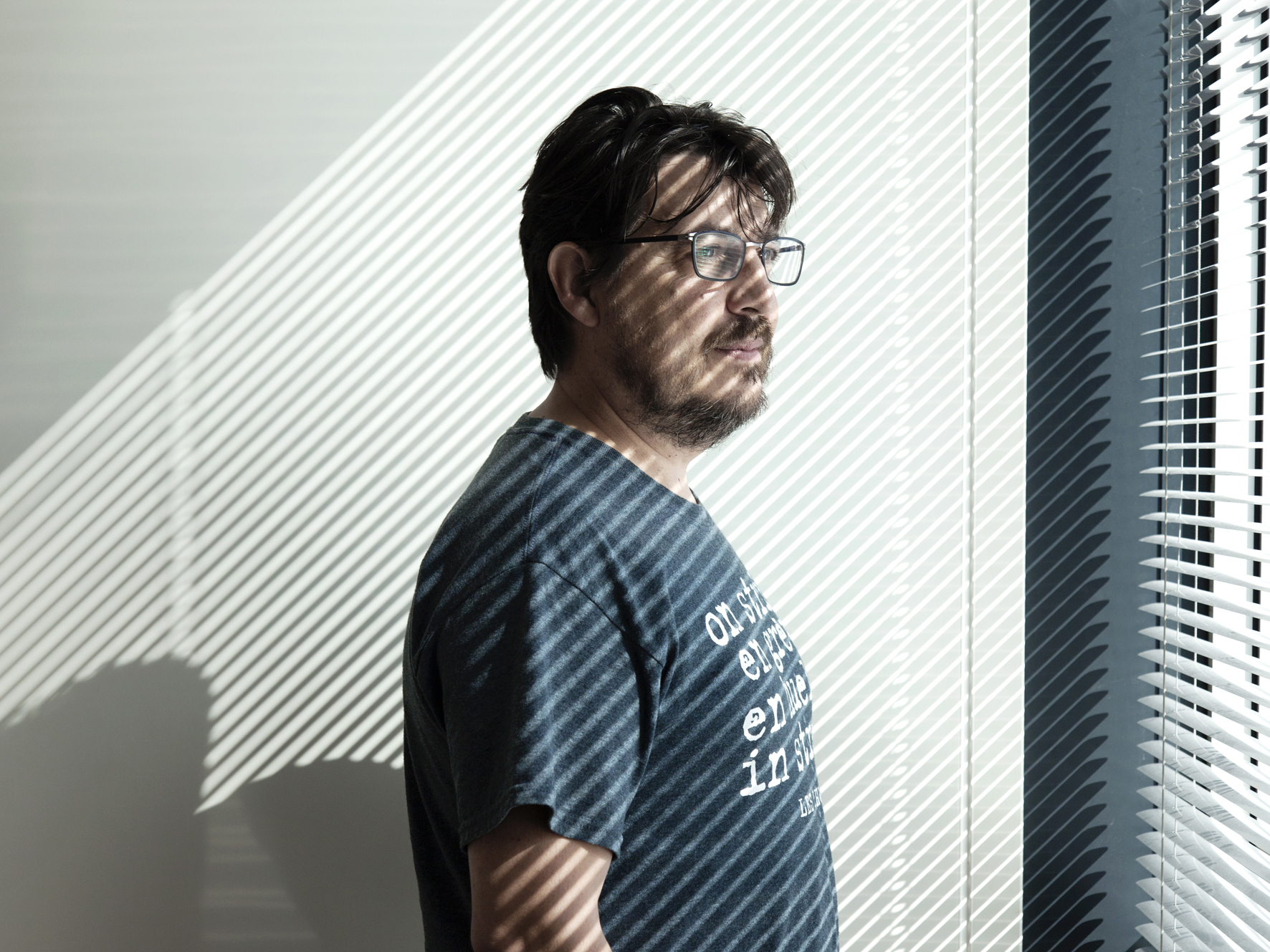
Journalist David Dufresne is monitoring police violence

David Dufresne. Photo: Patrice Normand, CC BY-SA 4.0

By Delphine Bauer

For more than one year now, French journalists covering social demonstrations  have been facing increasing levels of police violence. It comes as the ECPMF and partners prepare to launch their Press Freedom Police Codex in France.

Insulted, threatened or physically assaulted, the French reporters are concerned that they are seeing press freedom  being eroded before their very eyes.

“Our collective was born out of a  feeling of great fatigue: we were fed up with seeing journalists arrested in front of police stations or press boxes  and denouncing violence against us without seeing any change.” Eloïse Bajou, who works as a freelance journalist and photographer, is a 41 year old member of the  new reporters’ collective called REC (Reporters En Colère, which translates as  ‘Reporters in a rage’). The members of REC have three main goals: developing their collective action, raising awareness amongst citizens and asking questions in the political community. “At the sites of the social demonstrations that have emerged in the French social landscape for years now, we always find the same team of reporters. Each time, we talk about what happens to us – arrests or even injuries. Eventually, we felt we had to do something”, she explains. In November 2019, one year after the start of the Gilets Jaunes (Yellow Vests) movement, the collective was officially launched. Their biggest concerns? “Confiscation of equipment, insults, threats and missiles thrown at some journalists“, Eloïse Bajou describes the main problems.

More than 120 incidents

In the eyes of Reporters Sans Frontières (RSF), an NGO that defends journalists’ rights, “The French journalists have faced an exceptional level of violence, especially in the first six months of the Gilets Jaunes demonstrations (from November 2018 to May 2019) “, declares Pauline Adès-Mével, the RSF spokeswoman in charge of this issue. According to their data, RSF have counted more than 120  incidents involving journalists, on a regular basis and during marches all over the country, and more than 54 journalists have been injured. “I cannot remember any such intensity of injuries among journalists“, confirms Sebastian Roché, a French political scientist. The over-representation of journalists among the casualties cannot be just an accident since they’re a minority of all the people at the demonstrations. The political scientist explains: ”There’s a body of evidence that shows the protection of journalists is clearly not a priority for the government nor for the police hierarchy. On the contrary we can see a limitation of the freedom to inform, based on the wider use of the French Anti-terrorism Act“.

From the police’s side, an internal source puts the statistics in context, explaining that the law enforcement authorities have been overstretched  recently, and that created a specific and tightly-regulated atmosphere during the demonstrations. Some specific difficulties could have made the work on the field even more complicated for police officers : “ We have to deal with unorganised, popular and spontaneous events,  sometimes with no internal security staff (stewards), and with the presence of black blocs, who don’t march in a peaceful state of mind“, the source says.

A  high level of violence

Besides, again according to that police source, “There’s a real problem with journalists, as they’re not always identifiables. Anyone can pretend to be a journalist. Some of them are, but some aren’t”. Eloïse Bajou doesn’t share that point of view  at all and she’s pleased to note that the journalists’ unions have supported journalists under threat, with or without a press card. “It’s not the role of the police to decide who and who isn’t journalist“, she stresses. RSF agrees on that point, which seems to be unanimously a non-issue from the journalism side. “We defend  journalists in the same way, whether they have a press card or not. As long as they work for a media outlet and document the demonstrations, we show the same commitment. We can’t tolerate that journalists are being beaten up in this way “, says Pauline Adès-Mével.

In fact, the question of the press card doesn’t change the challenges that all reporters on the Gilets Jaunes beat have to deal with. Even while they’re causing no trouble but peacefully doing their jobs, they’re nevertheless sometimes intentionally targeted as journalists . And among all the casualties, “They’re over-represented“, insists Sebastian Roché. On the 20th of December 2019, RSF decided to support and help thirteen journalists who have been injured last year to file a lawsuit for deliberate violence and actual bodily harm perpetrated by a representative of a public authority. Among them, the photojournalist Xavier Léoty, who suffered a broken knee caused by the shooting of an LBD grenade (12.01.19) and more recently, the Turkish photojournalist Mustafa Yalcin, who has a serious eye injury after being shot with a grenade (5.12.19). Editors note: LBD stands for ’lanceur de balle de défense’ or ’defensive missile launcher’.

Well-documented cases

“More cases may exist but these ones are very well documented and absolutely certain: we’ve got videos, pictures, testimonies… “, says Pauline Adès-Mével. Even if so far, no officer  has yet been reprimanded by the police hierarchy … to her, there was no option other than going for a trial since the reactions of the IGPN (the internal police investigation team), when contacted by victims, have often been too slow or ineffective. Admittedly, our police source reminds us that the investigations are still ongoing. He doesn’t believe that there is general and systemic repression against journalists, but agrees that ”Individual police officers have responsibilities, irrespective of their rank”.

Surprisingly, David Dufresne (pictured above), a French investigative journalist whose name has become inseparable from the inventory of police brutality, concurs: “There’s no clear order to attack journalists“. But he’s not naïve: no official orders doesn’t mean there’s not an atmosphere of laisser-faire that leads to some risky situations for journalists. “There’s more and more physical contact between reporters and police, coming from a change of strategy over the last few years. It increases the risk of being injured. But the question is: when a reporter  gets a smoke grenade in the face, how is it possible to justify this action since a camera is not a weapon ? It’s only a weapon in cases where there is a lack of ethics.. Some non-lethal weapons should be only used in cases of legitimate self-defence, and that rule is not always respected,” he regrets.

A democratic issue

Since the start of the Gilets Jaunes (Yellow Vests) movement, David Dufresne’s done a huge amount of work to record the cases of injured demonstrators and journalists.  By becoming a point of reference,he considers that police violences have been under-reported by the French media, who are reluctant to denounce those abuses because of political reasons and conflict of interest issues. As a response of the standardisation of information relayed by global media outlets, he salutes the determination of the most precarious reporters, who  cover the heart of the demonstrations, and witness potential abuses at very close quarters. Their mission is absolutely needed as a democratic counter-balance. “I feel like I have no other choice than to cover the demonstrations. We have to be there, and I probably feel even twice as motivated to do so when I see the violence that we have to overcome“, says Eloïse Bajou. David Dufresne notes that “ So far, the government has remained silent when it comes to police violence. I’m concerned because we have switched from a law enforcement model to a repression model “, he says. When abuses are committed ( videos deleted,  press cards torn, equipment broken, grenades thrown into people’s face even though face it’s strictly forbidden), ”Journalists become unwanted witnesses”, explains David Dufresne. Strictly supporting the 12th article of the Declaration of the Rights of Man and of the Citizen, which affirms that the activities of the police have to serve the people and not those in power at the time, he continues to report serious physical attacks against journalists. So far, he’s documented more than 800 cases of violence or unethical violations of the rules by the police (police officers wearing a hood, with no RIO identification number, for example …) All these incidents take place in a more global and national context, where “France has in the last decade lost its position amongst the world’s full democracies and joined the group of partially democratic states”, according to Sebastian Roché.

Meeting with France’s Interior Minister

On the issue of how journalists are treated during demonstrations, RSF has great expectations.  “We’ve met Christophe Castaner (Interior Minister) and we have asked for a list to be circulated demanding that police officers must   respect the practice of journalism and preserve the freedom of information”, explains Pauline Adès-Mével. In the next few months, the new law enforcement schema should be formalised. She hopes that the RSF’s recommendations – for  better consultation between the two professions, a special training for the police to help them identify journalists, a more effective way to sanction abuses – will be included. “The government has to send us a sign of goodwill. We won’t let the police keep on attacking journalists and we won’t let the justice system remain silent. “ Even if our police source says that journalists should take part in police training to better understand their way of dealing with security, he also confesses that “being responsible for the loss of an eye is far from edifying“.  So reconciliation won’t be easy. “ The government held captive by its rhetoric of confrontation, minimising the violence and failing to find solutions so far. It no longer knows how to get out of this situation “, concludes Sebastian Roché

Press Freedom Police Codex to launch in France

The European Press Freedom Police Codex, compiled by the European Centre for Press and Media Freedom and its partner organisation in dialogue with the police association EUROCOP, will be launched in the French language at a event in Paris on 22.January 2020.

The author Delphine Bauer is a 36 year old French freelance journalist. She’s a member of the freelancers collective Youpress. For years, she’s been covering international news (Middle-East, Africa, South-East Asia…) for French press and magazines. She’s recently started to focus on health issues, especially concerning women.


Outcry as Albanian politicians pass new laws restricting internet freedom

By | Albania, Mapping Media Freedom, Media Freedom

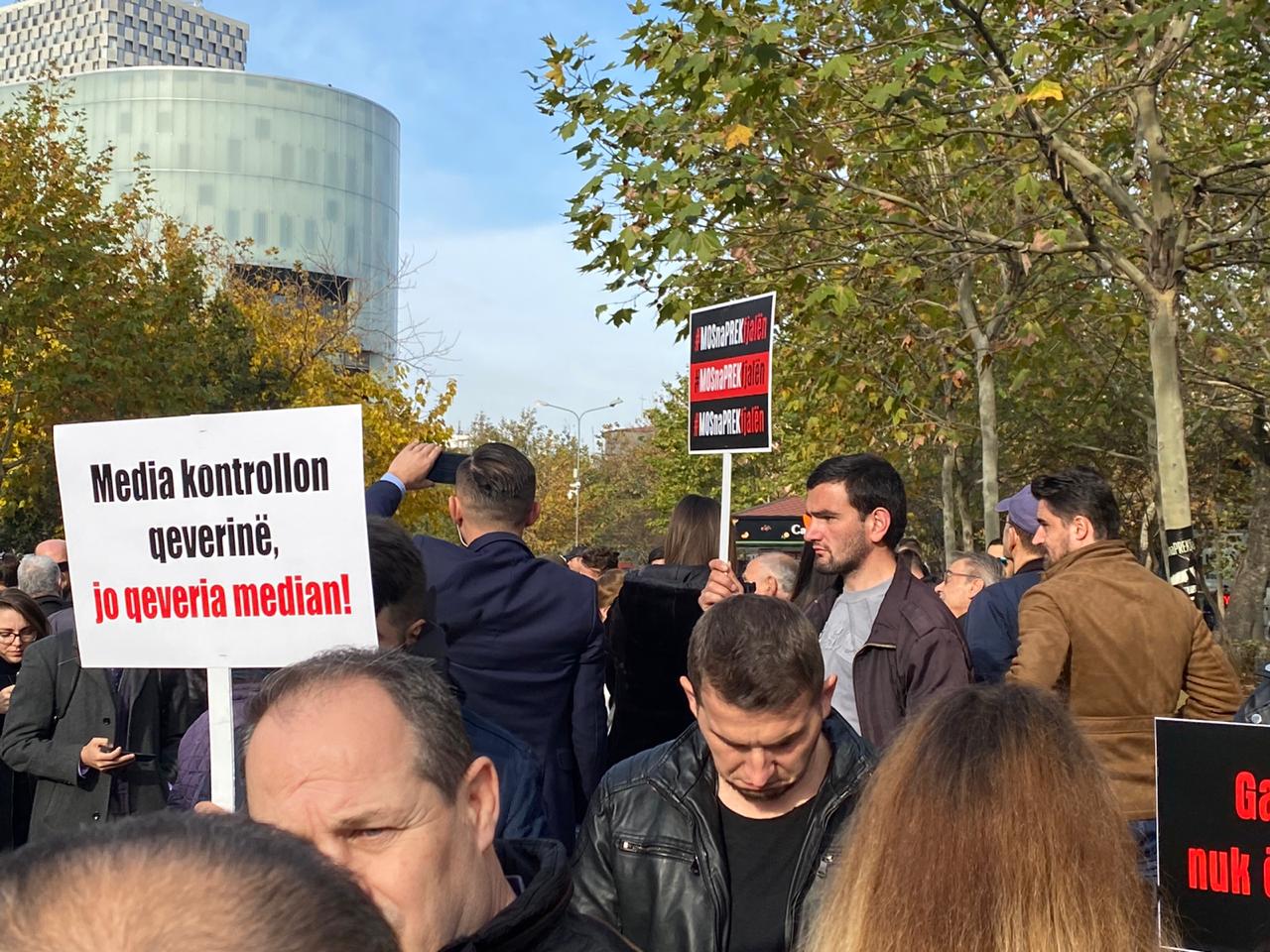
Hundreds of journalists and media freedom campaigners have come out onto the streets of the Albanian capital Tirana, protesting against a new draft law. Called the ’anti-defamation law’. If passed it would mean that a regulator appointed by the state would control online media through a process of registration. This is to say that self-regulation of online media will be replaced with state regulation. The main setback of these laws is that they abandon self-regulation. Additionally, the new provisions would also widen the powers of the Authority of Postal and Electronic Communications (AKEP), so that they could impose fines of up to 100,000 Lek (around 820 EUR) in the case of breaches or complaints.

When it was drafted, the new law was condemned in a joint statement of media freedom organisations back in July 2019. That was followed by the international press freedom mission to Albania, during which Prime Minister Edi Rama met mission representatives including the Legal Advisor of the European Centre for Press and Media Freedom (ECPMF), Flutura Kusari. In early December the organizations renewed their concerns.

Advocating for press and media freedom, Ms Kusari joined the demonstrations against the anti-defamation laws when it came back to the Albanian Parliament on 18 December 2019. She stressed: “This is a demonstration of solidarity. We are asking the parliament of Albania not to rush to adopt the controversial draft laws. We invite them to consult instead with local journalists, the Council of Europe, the European Union and other local and international media freedom organisations.“

Meanwhile Member of the European Parliament (MEP) David Lega, a Swedish representative of the European People’s Party (the largest political group in the European Parliament), has publicly warned Albania’s planned accession to the European Union will be put at risk, if its parliament approves the new media laws. In a tweet, Lega shared that the Copenhagen standards of press freedom and freedom of expression must be upheld before Albania could become an EU Member State.

ECPMF is working closely with local organisations and will continue to support them in addition to monitoring the situation in Albania.

Year of impunity shows how hard it is to get justice for journalists who are killed because of their work

By | Mapping Media Freedom, Media Freedom

Another Awareness Day reminds the world that reporters and media workers sometimes pay for the truth with their lives.
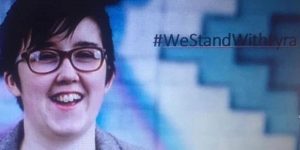
Year of impunity shows how hard it is to get justice for journalists who are killed because of their work Lyra McKee, who was killed in April 2019.

In the media freedom community, no reminders are required. The struggle for justice continues day by day, and the twelve months since the last United Nations Day to End Impunity for Crimes Against Journalists have produced no improvement in the situation.

In an interview with ECPMF, Ivor Gaber, a member of the UNESCO Committee on the Safety of Journalists describes what steps are being taken. And the ECPMF has joined other media freedom organisations in a strongly-worded statement calling for an end to impunity.

In Europe, two new 2019 murders remain unsolved.

Twenty-nine-year old investigative reporter Lyra McKee, an editor for Silicon Valley- based online portal Mediagazer was shot in the head during rioting in Derry, Northern Ireland on 18. April 2019. The town, also known as Londonderry, has witnessed a resurgence in sectarian violence between Republicans and Unionists. The two sides in the twenty-year-long civil war known as The Troubles have observed an official ceasefire since the Good Friday Agreement ended the fighting in 1998 But on Good Friday 2019 a breakaway Republican group, The New IRA, claimed responsibility for attacking police with petrol bombs, and for the shooting of Lyra McKee – which they described as ’an accident’.

No one has been charged with the murder. The Police Service of Northern Ireland (PSNI) has issued a compilation of video footage showing the prime suspects, and the investigative journalists’ collective bellingcat has also posted video footage on YouTube in an attempt to end impunity for the killer or killers. Read ECPMF’s interview with Christy Hunter of the PSNI here.

Investigative reporting published posthumously

Meanwhile a book based on Lyra McKee’s investigative journalistic research into historic crimes committed during the Trouble has been published by an independent Belfast publisher. Entitled “Angels with Blue Faces“. It reveals the cover-ups surrounding the murder of a Unionist politician and the sexual abuse of children from the Kincora Boys home. The publisher, Excalibur Press, is donating profits from the sale of the book to The Merlin Project, which enables young people from disadvantaged backgrounds to pursue careers as writers.

Just three weeks after the killing of Lyra McKee, Ukrainian reporter Vadym Komarov was attacked and severely beaten about the head with a heavy object in his home town of Cerkasy. He had been working to uncover alleged corruption involving a gymnastics centre. In a Facebook post, he wrote that he would publish details in the local daily newspaper Dzvin. Then came the assault. The attacker used such violence that Komarov fell into a coma and never recovered consciousness. On 20. June he died. His mobile phone and wallet were not touched during the attack and it is believed he was killed in order to prevent him publishing the results of his journalistic investigation.

“We condemn the murder of Vadym Komarov and call on the Ukrainian authorities to swiftly find his killers and bring them to justice, lest impunity embolden more would-be perpetrators, ” said Gulnaza Said of the Committee to Protect Journalists.

At the time of writing no-one has been charged in connection with the death.
Year of impunity shows how hard it is to get justice for journalists who are killed becasue of their work Vadym Komarov. Private photo posted on Facebook

The Council of Europe reports that 22 earlier cases of impunity are still ongoing. They include the murders of 14 Serbian and Albanian journalists. One name that is no longer on that particular list of shame is that of Slavko Curuvija, the Serbian editor and publisher who was assassinated in 1999. In April 2019 a court in Belgrade sentenced two of the four people involved in the killing to thirty years in jail. A third man received a twenty-year sentence. The fourth was tried and convicted in his absence and is still at large.

The murder case of Bulgarian journalist Viktoria Marinova was closed on 23. April 2019. Twenty-one year old Severin Krasimirov was sentenced to thirty years in jail after pleading guilty to the rape and murder of the TV presenter. It happened the day after Marinova presented the first edition of a new investigative TV series but the killing is not thought to be linked to her journalistic work.

Jan Kuciak murder trial continues

Charges have been laid on October 21 2019 against four people in connection with the murders of journalist Jan Kuciak and his fiancee Martina Kusnirova, shot dead at their home in Slovakia in 2017.

Daphne Caruana Galizia murder trial stalled

And in Malta investigations continue into who ordered the 2017 assassination of investigative reporter Daphne Caruana Galizia. The trial of four men accused of carrying out the car bomb assassination is due to start on 8.November 2019.

Following a visit to Malta and high-level report to the Council of Europe by Rapporteur Pieter Omtzigt, a public inquiry has been announced into whether the authorities could and should have saved her life, knowing that she had reported many threats and acts of intimidation. The inquiry team has not yet been finalised. But an air of impunity persists: two reporters Carlo Bonini and John Sweeney and blogger Manuel Delia, who published a book about the case have been threatened with legal action by the Maltese government, Daphne Caruana Galizia’s family continues to face a number of defamation cases which they must contest in court.

Air of impunity

And every night the flowers, candles and photographs laid in tribute to the murdered journalists at Valletta’s Great Siege Monument are cleared away and dumped by local authority workers – a clear signal that those in power do not accept responsibility for ensuring her safety or punishing those who commissioned the murder. The fact that Daphne’s supporters replace those tributes every single day shows just as clearly that impunity is not acceptable and the struggle for justice will continue.

By Jane Whyatt