All Posts By

Mapping Media Freedom

#ReportIt: When state funding discredits the press – The Romanian media is facing a financial and moral dilemma

By | COVID_19, ReportIt, Romania

By Dumitrița Holdiș, Project Manager at the Center for Independent Journalism (CIJ) Bucharest, Romania and non-resident fellow at the Center for Media, Data and Society at Central European University in Hungary.


Like every other branch of the economy, the media industry in Romania was severely impacted by the SARS-CoV-2 virus. Similar to other eastern European countries, Romania introduced firm measures to contain the virus in the spring of 2020 and the restrictions, which included a strict lockdown lasting for two months, had an immediate constricting effect on economic activity and created panic amongst economic actors. Although funding for the Romanian media often relies on “grey” funding from public institutions and municipal authorities the media is nevertheless heavily dependent on market mechanisms, like advertising. Thus, the signs of a crisis in the sector were looming.  Even business giants like Coca-Cola announced in March that they were suspending all marketing activities, including advertising, due to the crisis, and media companies were reporting severe drops in advertising income. Ironically, this was happening at a time when Romanians were practically becoming one with their television sets. Audience numbers for all TV channels and news programmes skyrocketed, online news portals were seeing record number of users and journalists were our proxies for the outside world. The media industry was becoming more “essential” yet it was losing income.

Associations representing the industry intervened and lobbied the government to come up with steps to save the press, as it did with other branches of the economy. The solution proposed by the government and embraced by a large number of organisations was to set up a so-called public information campaign with the twofold purpose of promoting safety measures, such as keeping social distance and wearing masks, and of supporting the media industry to recover from the crisis. The campaign was set to last four months, from May to September, and was funded with roughly 40 million euros. Later, the fund was supplemented and reached 50 million euros and the campaign was extended to the end of 2020. The money was awarded based on audience points – each point was worth roughly 90 euros – and institutions applying for funds had to declare a projected or estimated number of viewers for the government ads.

According to this logic, the biggest winners in the scheme were the big media players, such as private television channels which are already dominating financially the media market or media trust funds that own televisions, online media outlets and radio stations.  In a report recently published by the Center for Independent Journalism, it is estimated that a quarter of the money is about to go to the top 25 big players in the market, in a country where there are thousands of media organisations. The report also argues that the logic of distribution encourages and rewards ‘click-baiting’ and focuses heavily on traffic and indiscriminate audiences to measure success. Moreover, by rewarding the big market players, the government was doing the exact opposite of saving the press: the local press, the small independent media outlets, the written press was receiving almost no aid through this scheme.

Although generally hailed as a saving grace by the industry, the “advertising fund” as it is known in Romania, immediately raised critical voices. Smaller, independent media organisations came out publicly to denounce the fund and to raise questions on the effects it will have on public trust in the media. 2020 is an exceptional year all over the world. But in Romania it was more so as two important elections, local and parliamentary, are taking place this autumn. Seeing the government disburse money to the press in an electoral year, without any checks and balances, is not a flattering image. The Romanian public is notoriously distrustful of the media. Political figures contributed to discrediting a nosy press once the pandemic started affecting the country. Questions on the mismanagement of the crisis, on the poor allocation of funds for the health care system, on the number of casualties and infections were repeatedly reduced to accusations of false news or bad intentions. Now, the same government is funding the press to spread its message. Fears of self-censorship, political pressure and an erosion of credibility led some media outlets to publicly refuse to apply for funding.

“When the watchdog of democracy is fed by those in power, don’t expect it to bark too loudly”

wrote Dan Tăpălagă of G4Media, a small Bucharest-based online news site.

It echoed the fears of many journalists. But the money was a breath of air for many media organisations struggling to pay salaries, to fund reporting or to simply pay the rent.

A more complex effect of this funding scheme is related to increasing distrust in the government, the media, and also the reality of the pandemic. Covid denial is rife in Romania and distrust in public institutions and political leaders is fuelling such sentiment. The media is not just an industry or a branch of the economy and it should not be treated as such by any state. The effects of blanket distrust in the means of mass communication are visible in the scant respect the public has for anything communicated by the government. And if this discredited message is one that could save lives, the implications are lethal. The media sector can and must be supported in this time of crisis, but support should not cost the media its credibility.


ReportIt calls for all people to stand in solidarity with at-risk journalists and media workers by reporting all violations of media and press freedom to Mapping Media Freedom. Help us fight the normalisation of threats against journalists and stand up for media freedom by taking part here: https://www.mappingmediafreedom.org/report-it

#ReportIt: Mental Health – Protecting the wellbeing of journalists and media workers across Europe

By | Mapping Media Freedom, ReportIt

For World Mental Health Day (10th October 2020) ECPMF Helpdesk Manager, Katrin Schatz outlines the steps needed to protect the mental health and emotional wellbeing of journalists and media workers across Europe and what the Media Freedom Rapid Response can do to support

 In this piece, ‘women’ refers to all people who identify as women.

Given the nature of their work, according to research cited by the DART Center for Journalism and Trauma, between 80 and 100% of journalists and media workers have been exposed to traumatic events as part of their work from a range of different sources. They are often witnesses to traumatic events, ranging from armed conflicts, natural disasters and homicides to everyday tragedies like crime scenes, traffic accidents and domestic violence. As witnesses, while the trauma might not be experienced first-hand, it can still be felt vicariously and affect the journalists’ mental, physical, and emotional well-being.

As the situation of press and media freedom worldwide is deteriorating, this puts journalists and media workers further at risk from a wide range of direct and indirect physical, legal, psychological and digital safety threats. For instance, the majority of journalists have been exposed to intimidation and online harassment, solely for carrying out their work. For women, non-binary and LGBTI journalists as well as journalists of colour these attacks can be especially consistent and vicious.

The majority of journalists have been exposed to intimidation and online harassment, solely for carrying out their work.

Since the beginning of 2020, the Mapping Media Freedom platform has recorded 227 threats against press and media freedom in EU Member States and Candidate Countries. 122 (54%) relate to harassment and/or psychological abuse, such as intimidation, threats, sexual harassments and smear campaigns, as seen in the abuse directed at Florence Hainaut in Belgium and Miroslava Byrns in North Macedonia. Further to this, having to source and fund legal representation and participate in court cases related to legal threats, such as SLAPPs and defamation can affect a media professionals’ mental health.

The mental health of journalists is too often overlooked

Being constantly exposed to trauma, either first or second-hand, in-person or online, takes a toll and can have a significant impact on a person’s emotional health and willingness to continue their work safely. The psychological impact of this work can take various forms and is experienced differently by each individual due to the context, severity and frequency of exposure. Anxiety, depression, post-traumatic stress, and insomnia are common diagnoses, with further symptoms such as increased alertness, numbing and disassociation, intrusive memories, concentration problems, and overreaction to everyday events being associated with post-traumatic stress disorder.

This is a cultural issue as well. Stress is very much considered as part of the profession; the default state of contemporary newsroom culture. Irregular schedules, tight deadlines and potentially dangerous reporting environments are typical aspects of a career in journalism across Europe. This is further entrenched by diminishing resources for in-work support, fewer staff to alleviate pressures on individuals and insecure working contracts. The normalization of such working conditions, when twinned with stereotypes concerning bravery and grit can undermine the process of journalists and media workers acknowledging underlying mental health issues and seeking necessary support.

COVID-19 is affecting journalists’ mental health

In June 2020, the Reuters Institute for the Study of Journalism and the University of Toronto interviewed 73 journalists from international news organizations covering the pandemic. Early results state that around 70% of the respondents suffer from some levels of psychological distress, with further responses suggesting that 26% have clinically significant anxiety compatible with the diagnosis of Generalized Anxiety Disorder, symptoms of which include feelings of worry, feeling on edge, insomnia, poor concentration and fatigue. Around 11% of respondents report prominent symptoms of post-traumatic stress disorder, which include recurrent intrusive thoughts and memories of a traumatic COVID-19-related event, a desire to avoid recollections of the event, and feelings of guilt, fear, anger, horror and shame.

While these symptoms warrant immediate attention to support the journalists and media workers themselves, this is also a severe threat to the information society needs to understand and cope with the current public health crisis across the globe. By protecting the health of journalists and media workers we are protecting the health of our democracies and societies.

Media professionals need more support than ever coping with work related trauma

Journalists are as vulnerable to psychological trauma as they are to physical, digital and legal threats. Thus, psychosocial safety is of crucial importance and should not be seen as separate to other dimensions of safety. Approaching these threats holistically and preparing accordingly enhances the overall safety of journalists.

Psychosocial safety is of crucial importance and should not be seen as separate to other dimensions of safety.

Resources exist to ensure journalists can access the support they need. For instance, the Dart Center at Columbia University in New York is a resource hub on the topic of journalism and trauma. It provides guidance on how to report ethically on tragic and/or traumatic incidents as well as to protect oneself from their harmful effects. Further to that, many organisations publish guides and provide trainings related to mental health issues for journalists.

Where self-care is not sufficient and local support mechanisms are lacking, journalists can access psychological support through international organisations. Journalists based in EU Member State and Candidate Countries can receive financial assistance through the practical support fund of the Media Freedom Rapid Response: https://www.mfrr.eu/support/practical-support/


ReportIt calls for all people to stand in solidarity with at-risk journalists and media workers by reporting all violations of media and press freedom to Mapping Media Freedom. Help us fight the normalisation of threats against journalists and stand up for media freedom by taking part here: https://www.mappingmediafreedom.org/report-it

#ReportIt: The ever-present threat to democracy of gender-based violence and harassment

By | Mapping Media Freedom, ReportIt

By Roberta Knoll, European Centre for Press and Media Freedom

In this piece, ‘women’ refers to all people who identify as women.

“Watch when you are seen in public”. This was a message sent to reporter Marianna Spring in relation to her coverage of disinformation and social media for the BBC. In the response to one piece, it was not the only threat she received. Nor is she alone in receiving these sorts of threats.

“A big TV cannon comes over to me and tells me that if I do not suck his cock, then he will ruin my career. I said no.” With this announcement, the TV presenter Sophie Linde brought the worldwide solidarity movement #metoo to Danish media, reaching thousands of women.

Too often, online and offline harassment and threats, including threats of sexual violence are seen as the price women and non-binary people are expected to endure for speaking out. Together with the growth of social media and other internet platforms, attacks are able to reach more people from a wider number of sources, both named and pseudonymous. This leads to an even more hostile atmosphere for women journalists and media workers (TrollBusters & WMF 2018). Online harassment too often forms part of women’s daily routine; it is not an exception to the rule, it is rule. Moreover, it is not only the online environment where women face threats, with the offline world punctuated by similar types of threats. Threats faced offline are a global issue and they emerge from a number of different sources.

Online harassment too often forms part of women’s daily routine; it is not an exception to the rule, it is rule.

According to an IFJ report in 2017, 17 % of gender-based violence is perpetrated by colleagues, 38% by managers or supervisors, and 43 % by outsiders (IFJ 2017).

You cannot talk about media freedom violations without talking about gender

For example, in North Macedonia, you cannot talk about media freedom violations without talking about gender based violence and harassment. As monitored by The Association of Journalists of Macedonia (ZNM), 14 violations of media freedom have taken place since the beginning of 2020. Half of these targeted women. This issue has been amplified by the COVID-19 pandemic in unexpected ways. The 2020 Assembly election campaign took place against the backdrop of increased restrictions and lockdowns to respond to the pandemic. This resulted in most campaign events taking place online. While journalists have been physically assaulted during previous campaigns, with the events moving online, the abuse that followed in 2020 took on an explicitly gendered dimension with the targeted being predominantly women.

The complex mixing of being a women journalist

The two examples mentioned earlier exemplify different kinds of threats but follow similar structures: using existing power inequalities and deploying physical violence or threats to intimidate women journalists by restricting their space and attacking their willingness to speak out. While women journalists and media workers are more visible in public and able to voice their opinion, outdated misogynistic ideas surrounding gender roles and expectations of media representation feed the wide range of media freedom violations in Europe, ranging from online harassment, abuse in the public areas, up to physical violence and even murder. Women journalists and media workers face a double threat, the daily impact of structural inequality and the dangers working as journalists at a time where media actors are increasingly dehumanised or attacked. This results in a complex mixing of structural discrimination that impacts women disproportionately and may encourage many to step back from their work.

Women journalists and media workers face a double threat, the daily impact of structural inequality and the dangers working as journalists at a time where media actors are increasingly dehumanised or attacked.

Gender-based harassment as threat to democracy

This hostility when coupled with insecure working conditions cause trauma, fear, anxiety and mental health issues for the affected. This atmosphere requires significant resilience to continue working especially on sensitive and complex topics, such as corruption, abuses of power and increasingly, mainstream politics. Expecting women journalists and media workers to endure these threats as part of their day-to-day to work is unreasonable and demonstrates significant barriers to continuing work not present with their colleagues. Instead it is much more likely that this double burden leads to silencing and self-censorship of women journalists. Living in such consistent fear results in a reduced space within which they can work and express their expertise and opinions. This is an issue for the entire media environment as this threatens the plurality of voices present in society, narrowing the public sphere and as a result weakening democracy.

It is not only the victims themselves at risk; these threats affect us all, from our ability to access information that shapes our knowledge relating to the world around us to having our experiences represented in the media that can inform public opinion or policy.

Insights from Mapping Media Freedom platform

The monitoring platform mappingmediafreedom.org has registered around 63 alerts where women journalists were targeted or directly affected. Of course, this will only ever be a partial picture, as many victims do not report threats they have received or have come to expect them as the price for working as a journalist or media worker. These dynamics have also made it hard to accurately gauge the impact of gender-based harassment amongst journalists in Europe. According to the IFJ 2017 report, 48% of women journalists experienced violence at work.

Gender-based violence? #ReportIt!

The cases monitored to date already show the variety of threats women journalists face. They are diverse in intensity, geographical dissemination, source and nature. However, capturing as many incidents on Mapping Media Freedom helps us track, analysis and record these incidents. It is also a powerful act of solidarity to those at risk, demonstrating that they are not suffering alone.

Although the platform cannot singlehandedly dismantle the structure that sustains these threats, it is an effective tool to plot trends and see the bigger picture of what the situation is and of what needs to be done. The Media Freedom Rapid Response can only support the cases we know about and reporting every incident helps us reach those at risk.

We want to encourage everybody to report every kind of threat and abuse of women journalists and media workers to https://www.mapmf.org/report-it or you can contact our Women’s reporting point.

Gender-based violence is not normal, nor should it be accepted. It is a threat to media freedom and democracy. #ReportIt!

ReportIt calls for all people to stand in solidarity with at-risk journalists and media workers by reporting all violations of media and press freedom to Mapping Media Freedom. Help us fight the normalisation of threats against journalists and stand up for media freedom by taking part here: https://www.mappingmediafreedom.org/report-it


Photo: Clem Onojeghuo//unsplash

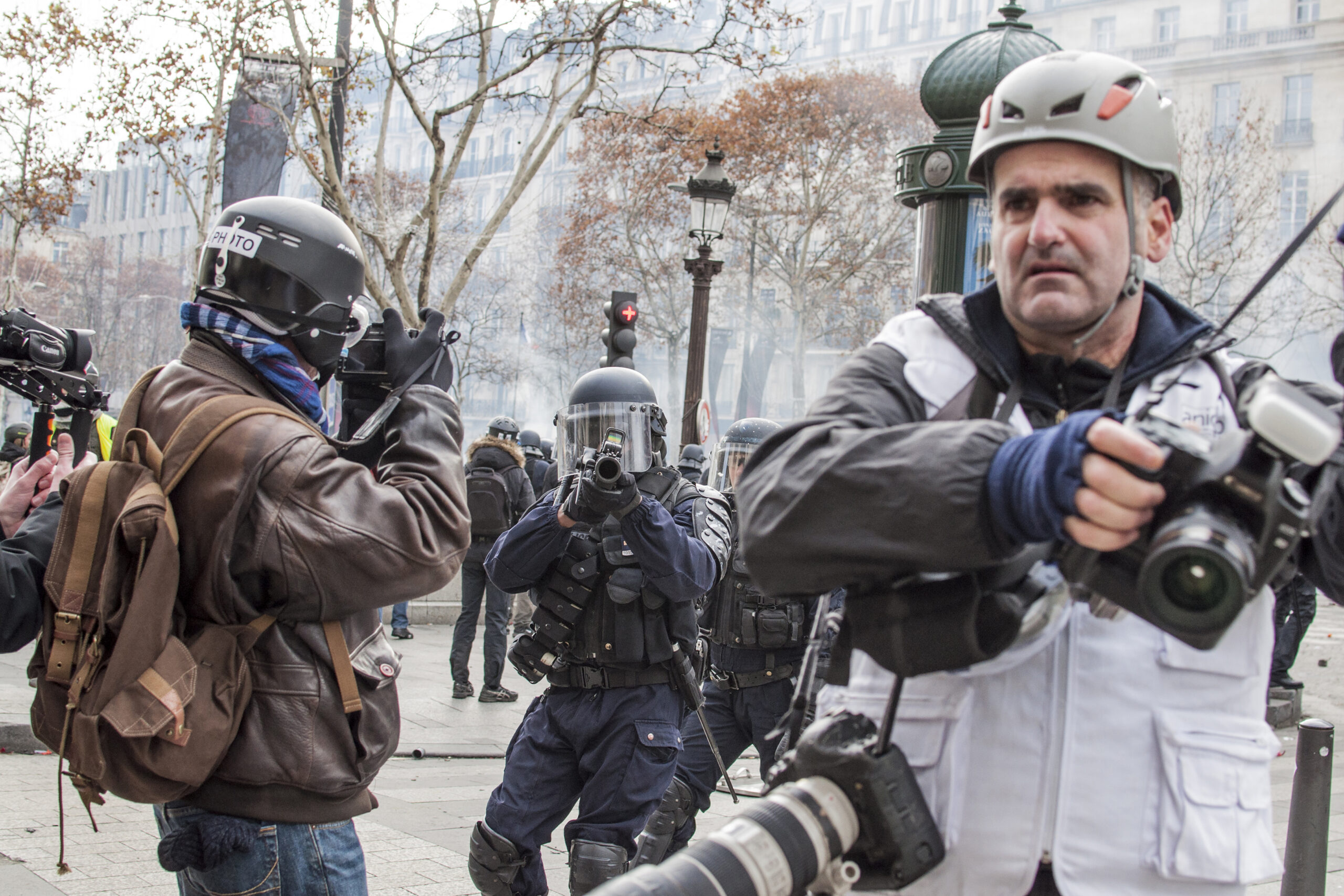
The photo shows journalists working during yellow vests, while police officers are pointing with a flash ball gun directly towards the viewer.

#ReportIt: Not a “normal procedure” – Police violence against the press in Europe

By | Mapping Media Freedom, ReportIt

by Martin Hoffmann, Vice Chair of the European Institute for Journalism and Communication Research (EIJC), Editor with ZDF heute journal and Researcher for ECPMF

113 journalists and media workers in EU Member States and Candidate States have suffered physical violence from police officers since 2014, according to MappingMediaFreedom.org. German video reporter Julian Stähle is one of those who have been attacked for carrying out their work. When filming a special services operation in the Berlin region, Stähle was injured when an officer suddenly threw him to the ground. However, it was Stähle who found himself in court. The officer who denounced him claimed that the reporter had started the confrontation. Two of his colleagues testified in support of this fiction. It took a year to prove that he was the victim of  the German police, not the perpetrator. Stähle was finally able to show his video-footage of the incident in the court. The footage was so damning that it made one of the officers who had just testifying under oath faint. Stähle’s experience of the police’s use of arbitrary violence caused public outrage and it remains one of the most egregious cases of police violence in Germany, while also demonstrating the extent to which police officers can attempt to avoid justice. Unfortunately this was not an isolated case. During the May Day demonstrations in Berlin this year a police officer hit a female camera-assistant so brutally, that several of her teeth were knocked out.

While this type of case is quite rare in Germany, in France the level of police violence against reporters is far more severe. In the first six months of the “Yellow Vests” protests, which began in November 2018, Reporter without Borders counted 54 journalists injured by police officers. 42 of them were severely injured. Journalist David Dufresne, who set up a monitoring process due to the increased reports of police misconduct connected to the Yellow Vest protests has registered several hundred cases of unethical behaviour. Every attack and every failure to respond undermines France’s commitment to media freedom and the underpinnings of democracy. If things are bad, the recently introduced National Policing plan will not improve matters. Designed as an approach for a “better consideration of the presence of journalists during law enforcement operations” as French minister of interior, Gérald Darmanin, called it, the current plan appears to miss its mark. It discriminates against journalists who are not holding officially accredited press cards, preventing them from wearing protective clothing such as helmets when covering demonstrations, while also enabling the police to exclude journalists from remaining in a crowd after police warnings.

Every attack and every failure to respond undermines France’s commitment to media freedom and the underpinnings of democracy.

But police violations of journalist’s rights happens across Europe. At the beginning of September 2020 in Sofia, Bulgaria, a camera team reporting on anti-government-protests were sprayed indiscriminately with pepper spray by police forces, others got allegedly hit with batons, while freelance journalist, Dimiter Kenarov was detained and allegedly kicked in the head by at least two riot police officers. Another alarming example of police misconduct was seen in Serbia during anti-lockdown protests in July where within only one week, 28 journalists were attacked by both police and protestors, as reported by the BIRN-network, other media outlets  and the Media Freedom Rapid Response.

These developments are even more concerning, when there is an increased need of proper police protection for journalists and media workers during their work. Demonstrations are currently the most dangerous situations for journalists to work both in EU Member States and Candidate Countries. More than 20 Percent of all violations against journalists occurred at demonstration sites in the first nine months of this year, according to data of MappingMediaFreedom.org. In Germany, 75 Percent of all violent attacks with political background were registered at demonstrations or in surrounding the environment.

These developments are even more concerning, when there is an increased need of proper police protection for journalists and media workers during their work.

This data demonstrates the increased necessity of building a professional and trustful relationship between press and police. To explore the current conflict and share perspectives, the Press Freedom Police Codex developed by the ECPMF and its partners formulates eight guidelines as to how police in Europe should support the work of the free press. The first rule states: Any violence by police staff against journalists is unacceptable. Even though this should be common sense in European democracies, it requires greater levels of awareness from the public, the police and politicians to ensure cases like the one of Julian Stähle are properly sanctioned and perceived as unacceptable to every police officer.

It is important to remember that in the police’s case against Stähle, their first reaction was for the head of the department to state unequivocally that the officer’s actions were correct and the assault and detention was “quite a normal procedure”, as Stähle resisted the instructions from the police. This approach may attempt to insulate police from further criticism, but does little to protect journalists and media workers. In fact, it is emblematic of a structural problem seen across Europe that, if left unaddressed, positions police officers, not as sources of support, but as sources of fear and distrust.

ReportIt calls for all people to stand in solidarity with at-risk journalists and media workers by reporting all violations of media and press freedom to Mapping Media Freedom. Help us fight the normalisation of threats against journalists and stand up for media freedom by taking part here: https://www.mappingmediafreedom.org/report-it


Photo: ©Dolidzé Sabrina

Piotr Stasiński

Gazeta Wyborcza’s Piotr Stasiński: “They want to bury us under an avalanche of lawsuits”

By | Features, Poland

Interview by Jane Whyatt and Lutz Kinkel

The Polish government seeks to control the public discourse. Gazeta Wyborza is a flagship for independent quality journalism – and because of that smeared as “anti-state” and “pro-European”. ECPMF talked to former deputy editor-in-chief Piotr Stasiński about SLAPPS, physical threats, “re-polonisation” and what keeps him going.


The origins of Gazeta Wyborcza are rooted in the social movement headed by the union Solidarność that eventually led to the collaps of the military regime in Poland and the communist block. Piotr Stasiński, former deputy editor-in-chief, now Special Media Advisor, was one of the dissident journalists contributing to this movement. The first issue of the newly founded newspaper was published 8 May 1989.

Gazeta Wyborcza building

Gazeta Wyborcza building. Picture @Gazeta Wyborcza

Still the Gazeta Wyborcza is regarded as the most important independent daily newspaper in Poland, nevertheless it is under massive pressure. Beginning in July ECPMF supported the newspaper with a grant of 15.000 Euros to fight SLAPPs (Strategic Litigation Against Public Participation). Currently the management faces more than 50 lawsuits.

The interview with Stasiński was conducted on the phone by ECPMF staffers Jane Whyatt and Lutz Kinkel.


ECPMF: Mr Stasiński, is the press still free in Poland?

 Piotr Stasiński: The press is free, especially the printed press and the online services. There is no censorship. However, all liberal media face massive pressures. The media landscape is divided – half of it tries to sell quality journalism, the other half tips out propaganda.

Andrzej Duda, candidate of the governing PiS party, recently won the presidential elections. There were accusations, that public TV favoured Duda in a very one-sided way. What role does Polish public radio and TV play?

A very important role. Public television is watched all over Poland, they have the widest geographical coverage and the largest audience. Mostly it is watched in the so-called provinces, in rural areas and small towns.

Nevertheless, TVP is not public anymore, it is now called ‘national’. In fact, it is government television. The audience is exposed to scandalous, horrible propaganda, including all kinds of invectives and accusations against the political opposition and democratic minded media like Gazeta Wyborcza or TVN, which belongs to the American Discovery Channel.

Private TV channels are said to have favoured Duda’s opponent Rafał Trzaskowski in a one-sided way. Is that true – and another sign of polarization?

Poland is completely polarised but there is no symmetry between, for instance, state-controlled TVP and private, independent TVN. There’s a large difference between propaganda and the far more impartial journalism of TVN. For example, all of Duda’s meetings during the presidential election campaign were transmitted by TVN, at least in shorter versions. But his rival’s meetings were not shown on TVP.

During the campaign Duda attacked the Poland correspondent of the German daily “Die Welt” personally. What’s the strategy behind this?

This is directed at people who have old anti-German feelings from the time of World War II. The sentiments are vague and and get lower year by year. A lot of people travel to Germany, hundreds of thousands of Poles work there, a campaign like this doesn’t impress them. However, using xenophobic language, especially against Germans, works with some parts of the rural population. This is how the government campaigns: inciting fear and then managing fear. They are managing bad emotions.

Duda also attacked the publishers of Ringier-Springer for interfering in the elections. Do we face a new debate on „re-polonising the media“ in your country?

Yes. The government has the law prepared and there is a way to make it look plausible. It’s very easy to create an anti-concentration law using the argument that Germany, France and other EU-countries also regulate their media markets. For instance, the government might forbid the owner of a nationwide newspaper to additionally operate nationwide websites. If someone ownes a nationwide TV they might not be eligble to also have newspapers, and so on and so forth. This kind of law is very easy to manipulate. It depends on how you define the market. If they want to punish a foreign investor who has more than one media outlet – here we go.

Could another method of “re-polonisation” be to avoid passing a law and simply pressure owners into selling their media outlets?

Exactly. For instance, the German publisher Passauer Neue Presse has the majority of local and regional nespapers. These are traditional titles from 50 years ago and people are accustomed to them. “This is our paper“, they think. These newspapers are very important to the electoral base of the PiS party. There were rumours that Passauer Neue Presse – in Poland they call themselves Polska Press – is going to be bought for a huge sum of money before the local elections. The sum was provided by state owned enterprises: oil companies, the largest insurance, the state-owned bank PKO PB. Polska Press probably refused to sell. But it is clear that this offer may be repeated. Look at what happened in Hungary.

Are the policies in Hungary a role model for the current government in Poland?

 Very much so. Already in 2016 PiS-party leader Jaroslaw Kaczynski stated in public that he wanted “Budapest in Warsaw”. We have a lot of contacts with Hungarian journalists who sympathize with us. The situation over there is horrible.

What does the political pressure in Poland do to your newspaper, Gazeta Wyborcza?

 We are treated as a kind of public enemy here. PiS-politicians and their followers name us “traitors”, they claim we are “anti-state”, “anti-government”, “pro European”, “pro German”, they even call us “pro Russian” or simply “Jews”. Outlets from the PiS media sphere frequently label us “Polish language newspaper”. This is to insinuate we are not Polish, but only use the Polish language to lie to our audience. This kind of humiliating language is our everyday experience. One of the fascists in the Polish Parliament, Grzegorz Braun, publicly said, we should be shot dead.

As you know, language prepares action, that’s why there are also physical assaults. For instance, our photographers were attacked and accused by the police, when they wanted to cover a demonstration in front of the house that belongs to Jaroslaw Kaczynski.


Gazeta Wyborcza

                                                    Gazeta Wyborcza newsroom. Picture @Gazeta Wyborcza

ECPMF supports Gazeta Wyborcza with a grant to fight so called SLAPP: Strategic Litigation against Public Participation. Could you please explain the type litigations and the intensions behind them?


When we criticise the government for its conflicts with the European Union or the Venice Commission; when we criticise them for violating the constitution and suppressing the opposition; when we criticise the restriction of gatherings and the reduced possibilities to demonstrate: we feel this is part of our obligation to the public. We have to do journalism, otherwise we are unnecessary.

However, the ruling party regards our work as “anti-Polish” and claims we would destroy the raison d’etat of our country.

Subsequently, the vast majority of lawsuits concern articles or videos on the website, that are critical of the government, government agencies or state-owned companies. Usually, the plaintiff demands a correction – and, of course, an apology, preferrably in national TV, and also high ‘damages’, financial compensation. But no, we won’t aplogize. Of course we are not perfect. There are some mistakes, usually rather small ones. If we see them, we correct them. But SLAPPs are not about that. In fact, they want to burry us under and avalanche of lawsuits. Currently, we have more than 50 litigations going on! I think there are five – from national television, PiS paty, the Ministry of Justice, state owned companies and the Polish copper conglomerate – because we criticised the face masks that were brought to Poland in the famous Antonov transport plane. And all of these facemasks proved to be worthless, their certificates were falsified, it was pure propaganda bullshit. However, the prime minister ordered state owned companies to buy them. This is absolutey crazy, this is like Kasachstan! And they sue us. They want a correction. Outrageous. Of course, we will defend the author.

More than 50 lawsuits at the same time: how do you handle that?

This is pure harassment. We should do our journalistic work. But I have to spend a lot of time talking with our lawyer, which is even more complicated now, because we work remotely, and we have to put signatures on the elaborate responses to the prosecutors office or plaintiffs. I have to go to the court and be a witness. We invest a lot of time for nothing. Our lawyer, who is one of the best in Poland, works day and night. This is harassment. Just harassment.

Can you still rely on the Polish judiciary?

We won the famous lawsuit against PiS party where we were indicted because a journalist used in his commentary the word “mafia state”. Eventually we won this in the Supreme Court because they were appealing and appealing. But this might be an exception. More and more courts, especially on the lower level, are controlled by the Ministry of Justice. And the Ministry is repeatedly sueing us. Currently we have around six lawsuits with them. Three or four of them concern one article, that is also a commentary. Not a factual article. And we made a mistake in this. It deals with the so called paedophile register, which is published by the Ministry of Justice. We were wrong in saying it was intentionally arranged in a way that avoids registering peadophile priests. We corrected this in the newspaper and online right the day after publication. But still they filed a lawsuit against us. I think most of the lawsuits come from them.

Will the EU’s Article 7 procedure against Poland initiate a change for the better?

Not really. I think, we have some insights from Brussels. The European Commission will try to find a way to co-operate with this government. Probably, they don’t have enough power and instruments to change the situation. The UE parliament is very different, it is very critical of what happens in Poland. In the Commission, there seems not enough movement, as I observe it. Especially, after the presidential election, when half of the population voted for Andrzej Duda, a PiS candidate. Again, Brussels has to deal with a president that calls the EU an “imaginary community”, and says that LGBT+ people are not human but an ‘ideology’.

How does the newspaper survive in such an environment? Can you participate in the advertisement market at least?

We don’t get any ads from any state affiliated entity. Even not the ads announcing bids for European funds. They were all withdrawn, when PiS came to power. The same happened to Newsweek Polska, which belongs to Ringier-Springer. This is a hard hit on revenues, of course. Instead, the ads go to PiS friendly media outlets. Some of them are very small, economically it makes no sense to publish any ad there, but they do it. It is a hidden subvention, no: a donation for being PiS friendly.

What’s more is the subscriptions. Gazeta Wyborcza was the largest and most important newspaper in Poland, every authority or state affiliated agency had a subscription of the print version and later of the online service. But not now. All subscriptions were cancelled.

 On the other hand, you have an enormous number of digital subscripitions from private users.

 Before the rise of the internet we sold even 500.000 newspapers a day on average. Now it is much, much less, in the average less than 100.000. But we are growing in paid digital subscriptions. Our strategy – we learned a lot from the New York Times – is quite successful, we have more than 240.000 paid subscribtions. Unfortunately, these subscribtions are comparetivly cheap and they do not bring us enough revenue to maintain our journalists. Still the printed newspaper makes more revenue than the digital subscriptions.

Luckily, we are owned by Agora, a public company. One of the funds of George Soros holds around 11 percent of our shares at the stock-market, which is also helpful. It protects us against a hostile takeover. The owners cannot be intimidated easily.

Since the PiS took over the government in 2015 Poland fell in the Reporters Without Borders Index from position 18 to 62. Do you see any chance to stop this development?

I think it will get worse, because the government publicly threatens the quality press even more now. Zbigniew Ziobro, Minister of Justice, says it is time to regulate the media, to make them behave orderly. Another vice-minister, in charge of the state-owned companies, says it is time for re-polonisation and deconcentration. There will be all kinds of pressures, not only the ones I mentioned before. The third largest TV station is called Polsat and belongs to one of the richest Polish businessmen. He owns many enterprises, for instance energy companies, whose profit depends on state regulation. Recently he made changes in the staff of the news-service in favor of journalists who seem to be more PiS leaning, or at least sympathetic with the PiS authorities.

On the other side, we see that already a few PiS parlamentarians are named CEO’s of private companies. Because of COVID-19 and the economic crisis these companies need financial government aid – as in other countries. This is how they pave the way to subsidies: making PiS parlamentarians their managers.

How would you describe your journalistic approach of the Gazeta Wyborzca?

We are an important institution of democracy. I wouldn’t regard myself being a part of the ‘fourth estate’. No. This metaphor is too much. But we are part of democracy. When the Nixon administration sued the New York Times and the Washington Post to prohibit the publication of the Pentagon Papers scandal, a justice of the US Supreme Court said, quoting the constitution of the United States: the press is to serve the governed, not the governors. This is the motto I believe very much in. It is existential for us.