Russia’s media freedom has declined under the government of Vladimir Putin. The president and his allies have used a cloak of legislative legitimacy to target potential opposition to his rule.
Read More

Russia’s media freedom has declined under the government of Vladimir Putin. The president and his allies have used a cloak of legislative legitimacy to target potential opposition to his rule.
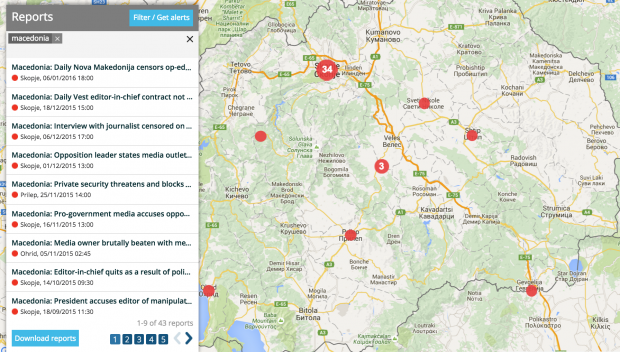
If you want to understand the media environment in North Macedonia, the phenomenon of parallel journalists’ organisations is a good place to start.
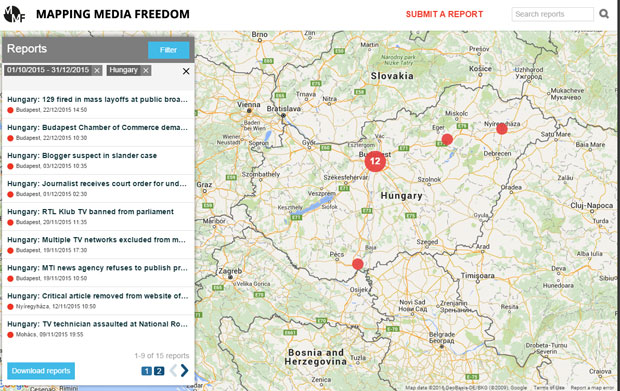
Hungary’s media outlets are coming under increasing pressure from lawsuits, restrictions on what they can publish and high fees for freedom of information requests
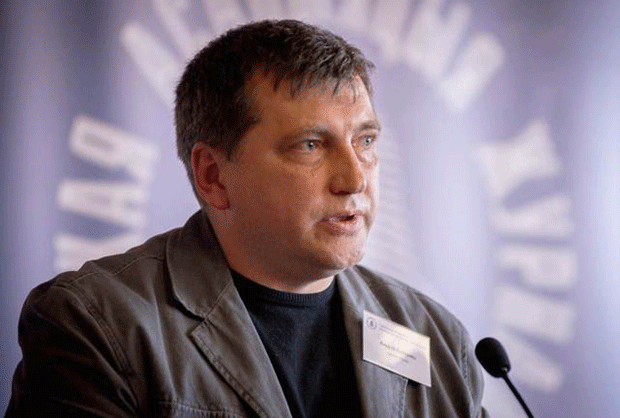
Belarusian authorities were busy in 2015: the government introduced new laws aimed at restricting media outlets and distributors; freelance journalists contributing to foreign media outlets found themselves facing prosecution; and websites publishing material that “may harm the national interests of the Republic of Belarus” were extrajudicially blocked.
Since October 2015, Index on Censorship’s Mapping Media Freedom project has recorded a total of 40 verified violations against press freedom in Ukraine, six of which took place in Crimea.
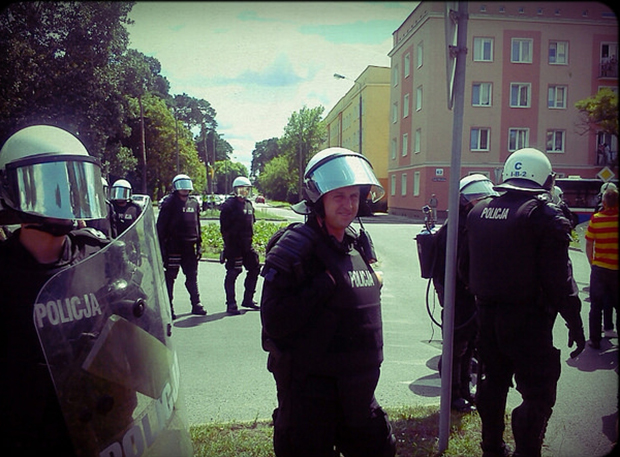
Polish police. Credit: Flickr / Kamil Gopaniuk
A recent audit by the bureau of internal affairs (BSW) has uncovered two informal press surveillance units of the Polish police that were set up to monitor journalists in connection with the “tape scandal” for one year between 2014-15.
The “tape scandal” refers to a series of secretly recorded conversations between leading political figures that occurred at a well-known restaurant in Warsaw.
As the daily Rzeczpospolita reveals, the surveillance units, made up of 29 policemen, were quickly formed following the publication of recordings of conversations in 2014 Read More


Mapping Media Freedom documents press and media freedom violations across Europe. The documented incidents are publicly accessible and can be explored, filtered and searched through the interactive Alert Explorer. Quantitative and qualitative analysis providing deeper insights and statistics about the press freedom situation in Europe is published within regular monitoring reports and fact sheets.
This project is run by the Media Freedom Rapid Response (MFRR), a Europe-wide mechanism, which tracks, monitors, and reacts to violations of press and media freedom in EU Member States and candidate countries. This project provides legal support, public advocacy, and information to protect journalists and media workers.

 All content available on the Mapping Medea Freedom website is licensed under a Creative Commons Attribution-NonCommercial-ShareAlike 4.0 International License.